
Board counsel briefs members on California rulemaking process and timelines
Get AI-powered insights, summaries, and transcripts
Sign Up Free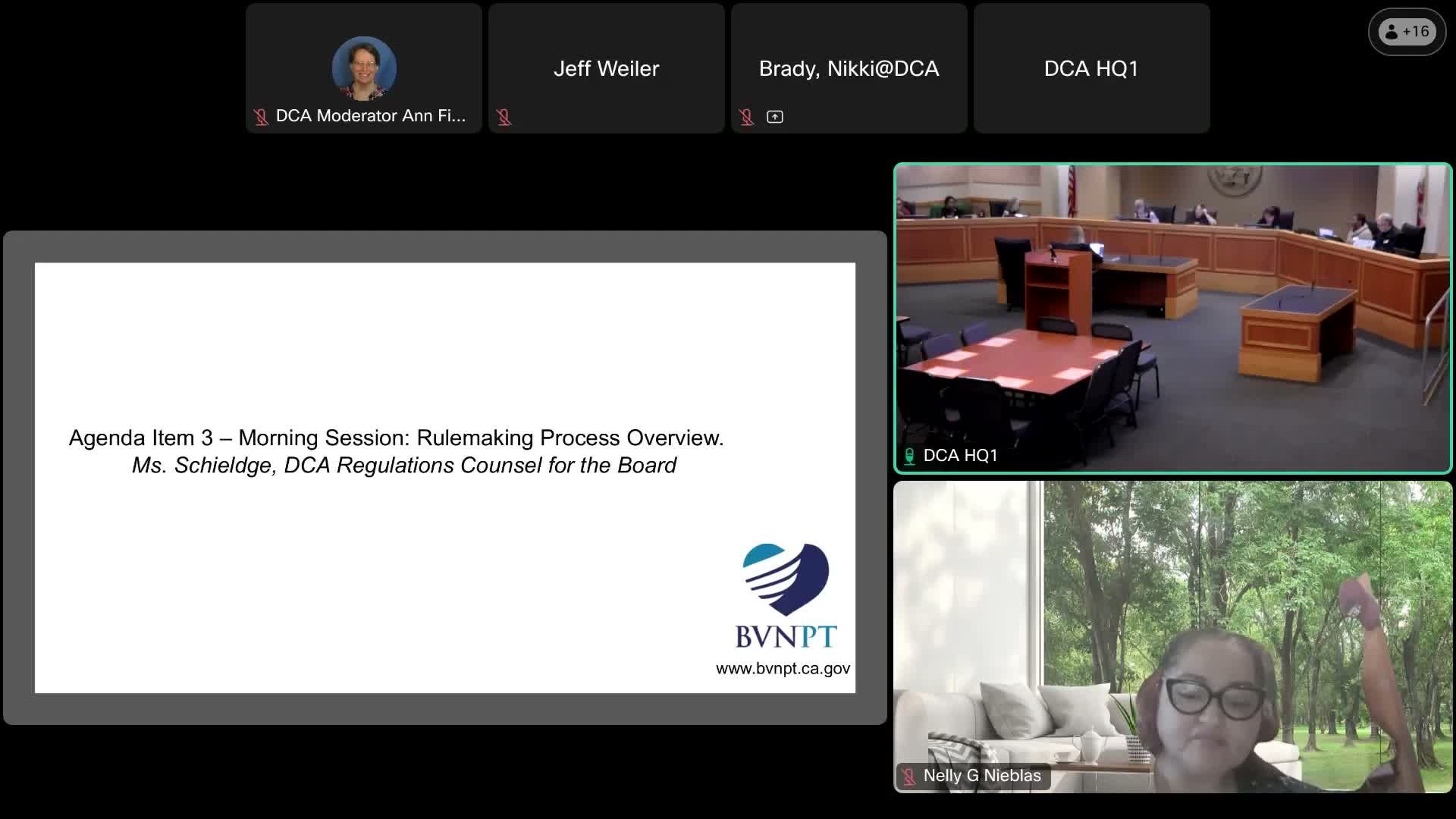
Summary
Regulations counsel Christy Shields gave the Board of Vocational Nursing and Psychiatric Technicians a step-by-step primer on adopting regulations under the California Administrative Procedure Act, highlighting required filings, control-agency review, comment windows and timing constraints that can extend rulemaking to more than a year.
Christy Shields, regulations counsel for the Department of Consumer Affairs, told the Board of Vocational Nursing and Psychiatric Technicians on Feb. 5 that regulations carry the force of law and agencies must follow the California Administrative Procedure Act when adopting, amending or repealing rules.
Shields summarized the process and practical timing. "Since regulations have the force of law, state agencies must follow the process aligned in the APA to ensure due process to those affected by the regulations proposed to be adopted," she said, and she cited Government Code section 11342.6 when explaining what counts as a regulation.
Shields outlined four internal stages the department uses — concept, production, initial and final — and the board’s role at each step. The production phase requires the staff and counsel to assemble an initial statement of reasons, fiscal and economic analyses when applicable, and supporting documents for submission to the Office of Administrative Law (OAL). She said OAL has an initial 10-day window to review a filing, the public comment period is 45 days, and control-agency review steps (including director review and Department of Finance review when there is a fiscal impact) commonly add multiple 30-day review windows, creating realistic timelines of a year or more for non-emergency rulemakings.
"If you ever look at a law and you don't know what it means right away, that's a clue that you might need a regulation to interpret that statute so everybody enforces the law in the same manner," Shields said, using a fee-range example to illustrate when regulations are needed.
Board members pressed on timing and conflicts with other agencies' regulations. Shields advised that rule text must be drafted in light of existing statutes and other boards' regulations to avoid OAL disapproval. On that point she said, "You have to look at all the laws that touch on the issue and come up with a proposal that is consistent and not in conflict with those other regulations out there." The board discussed potential overlap with the Respiratory Care Board and was advised to review statutory authority before advancing text.
Shields encouraged front-loading stakeholder engagement for complex or contentious proposals. She described options for committee-level stakeholder meetings to build consensus in advance of the formal 45-day public comment period and to reduce the volume of adverse comments during public notice.
Shields also reviewed how modified text is handled: if the board accepts public comments and modifies proposed language, the board must publish either a 15-day or a 45-day notice depending on the scope of modifications and whether they relate to the original rulemaking.
The presentation concluded with practical advice for board members: review staff memos and supporting documents in advance, decide whether to set hearings based on anticipated public interest, and use the strategic plan and rulemaking calendar to prioritize regulatory work.
Shields repeatedly emphasized that, absent emergency authority, the regular rulemaking timeline and multiple control-agency reviews typically make it difficult to implement statutory requirements on short legislative timetables. The board did not take any formal regulatory actions during this session; the briefing was educational.