Get Full Government Meeting Transcripts, Videos, & Alerts Forever!
Get email alerts on the Urban Forestry topic
No spam. Unsubscribe anytime.
Pensacola advisory board weighs smaller saplings to speed canopy restoration
Summary
Members heard a Canopy Restoration Project update, discussed changing the city's 3-inch minimum tree-caliper requirement to allow smaller saplings, and reviewed inspection and permit tracking via MyGovernment Online. A pending Tree Trust Fund application remains under internal review.
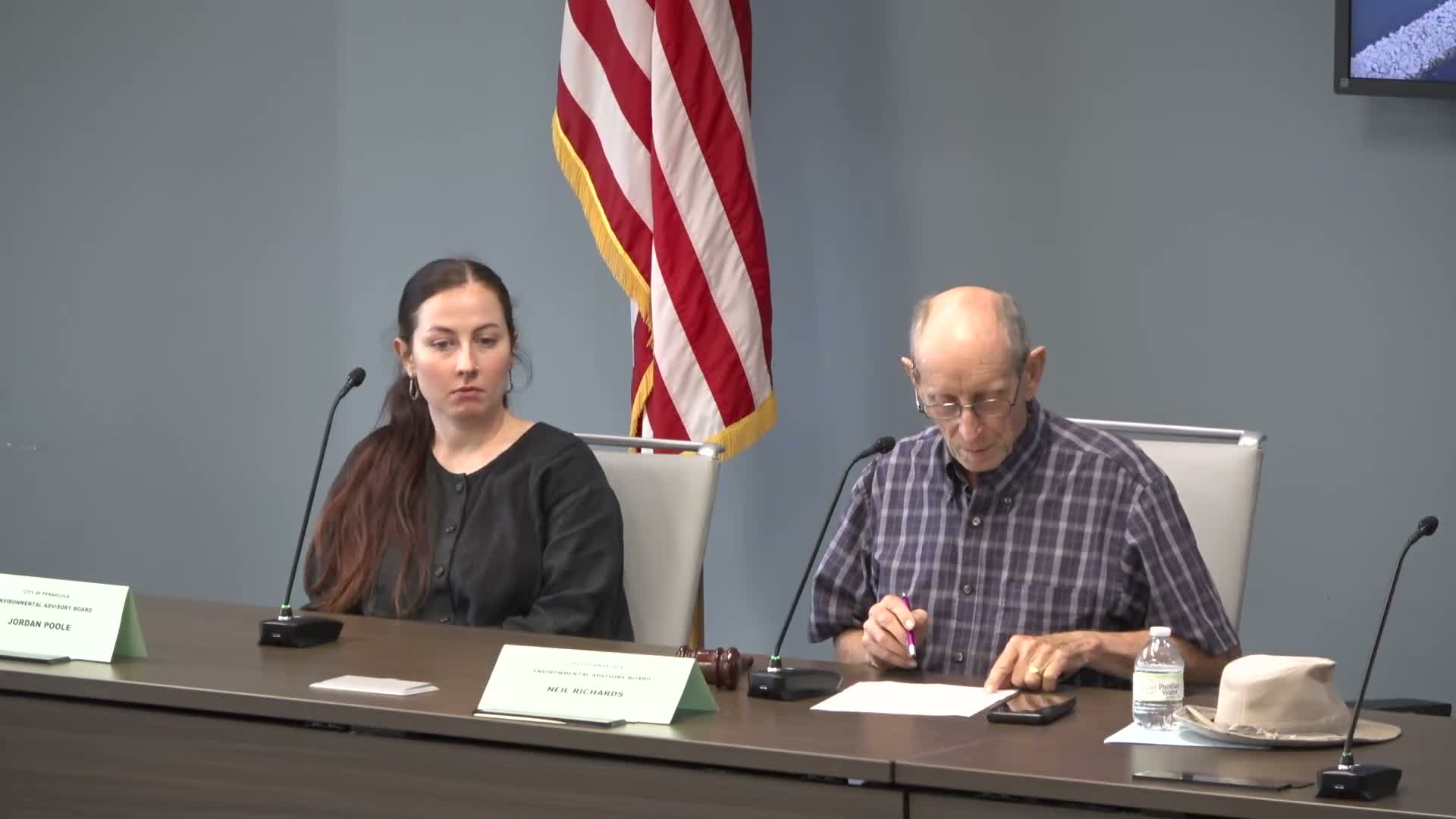
The City of Pensacola Environmental Advisory Board met in January and heard a detailed update on the Canopy Restoration Project and a discussion about whether the city's 3-inch caliper minimum for planted trees should be revised to permit smaller, less expensive saplings.
Representatives of the Canopy Restoration Project said the group planted about 87 trees on Dec. 6 and has planted more than 300 trees since December 2023. "We planted 87 trees," a project representative told the board, and the group described survival rates in the 90s, citing about a 98% survival rate for program trees. The group said that if it can run two projects a year of roughly 90 trees each it could reach a 1,000-tree goal within four years.
City staff told the board the ordinance currently requires trees planted to meet city standards to be a minimum 3-inch caliper (measured at diameter at breast height). "Currently, that is what is in our ordinance," a staff member said, adding that an ordinance change would require guidance from a new arborist and further internal review. Project representatives argued smaller trees (about 1 to 1.5 inches) can be planted at greater scale with lower per-tree costs and that, according to some arborists they consulted, 10-year size differences between 1- and 3-inch trees would be modest.
Staff also described the code's replacement requirements for removed trees: for example, trunks 4'11 inches in diameter generally require two 3-inch replacement trees, and a 44-inch trunk would require 11 3-inch trees, with spacing and landscape-plan requirements so mature canopy has room to grow. Those rules were presented as part of ensuring on-site replacement and broader canopy recovery.
Board members pressed on enforcement and follow-up. "There is supposed to be follow-up in our MGO system," a staff member said, referring to MyGovernment Online permitting and inspection workflows; staff said responsibility for inspections is shared among Bilby, engineering inspectors and the arborist and that a standard operating procedure is being drafted to ensure inspections are scheduled and assigned.
The board was also told a Tree Trust Fund application from a group led by Kelly has been submitted but not yet finished internal review; staff said the board could not vote on that application until internal steps are completed and suggested a possible February workshop to consider it.
Votes at a glance: the board unanimously approved minutes for the Sept. 4, 2025 and Nov. 6, 2025 meetings (motion moved by Jay; seconded by another board member). The minutes approval was procedural and recorded as unanimous approval.
What happens next: staff will continue internal reviews of the Tree Trust Fund application, finalize the standard operating procedure for permit follow-up in MyGovernment Online, and present any ordinance-change proposals only after arborist input and staff recommendation.