
Cranston planners hear neighbor outcry over Lake Street subdivision; variance vote ties, application continued
Get AI-powered insights, summaries, and transcripts
Subscribe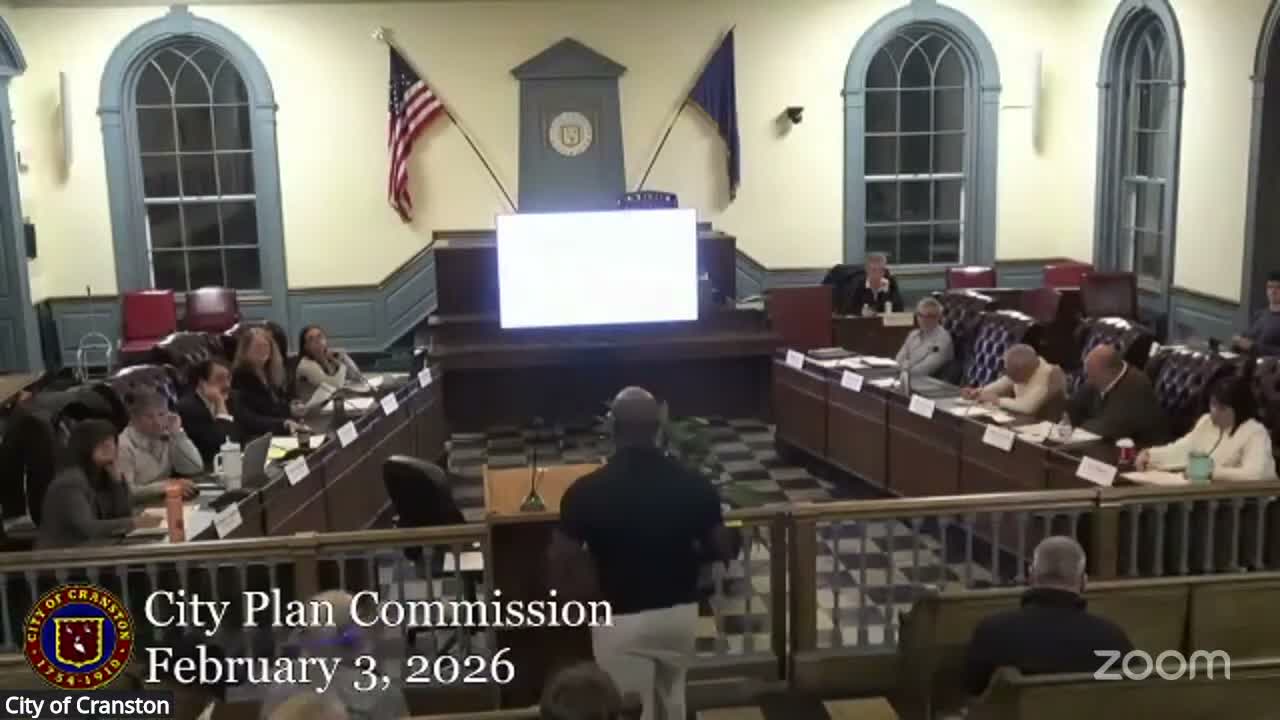
Summary
Neighbors told the City Plan Commission that repeated flooding, narrow streets and parking shortages make 33–35 Lake Street unsuitable for adding another house. Staff recommended approval with conditions; the commission deadlocked 3–3 on the zoning variance and voted to continue the application to March 3 while requesting additional stormwater and engineering materials.
The Cranston City Plan Commission on a winter evening heard more than an hour of testimony from neighbors who said chronic flooding, narrow streets and parking shortages make a proposed subdivision at 33–35 Lake Street a poor fit for more housing.
Seddik Davies, the applicant and owner of the Davies Group, asked the commission to reconfigure three existing parcels into two lots so an existing two-family would remain on one 4,800-square-foot lot and a new single-family house could be built on the other. Davies said the combined properties total about 9,600 square feet and that the site is not within a FEMA floodplain; he proposed a rain garden to limit added runoff.
Planning staff recommended approval, noting that the two proposed 4,800-square-foot lots would “mirror the existing use, density, and character of the development in this neighborhood” and that the proposal is generally consistent with the 2024 comprehensive plan and the future land-use map. Staff’s packet stated the resulting subdivision density would be 13.64 units per acre and offered approval conditioned on five items, including submission of a stormwater management plan, curb-to-curb pavement restoration, payment of impact fees and water/sewer availability letters.
Neighbors disputed the assessment that the location is buildable without additional study. “I bought the lot and I didn’t know what I was getting myself into,” said resident Ralph d’Ozzzi, who said his property and others flood deeply during routine storms. He added that he has lost vehicles to high water and urged the commission to require engineering that addresses the existing drainage before allowing more development on the street.
Other residents documented parking and safety impacts associated with undersized lots. “When there’s snow or cars, my driveway becomes unusable,” said Alexandria Kazarian, who offered photographs to the commission and asked that they be made part of the record. Mike DelMonaco told the commission he had seen a fire truck stopped in waist‑high water near the site and called flooding there a risk to first responders.
Commissioners pressed staff and the applicant about the omission of certain technical materials. Commissioner Lamphere asked how dividing lots and adding a house would “protect and stabilize” the neighborhood and emphasized missing data such as contours, soil analyses and total impervious surface area. Staff replied that the submission met the city’s certificate-of-completeness for a preliminary plan but acknowledged that public comment about flooding arrived after completeness was issued. Staff reiterated the recommendation: approval with a condition that a stormwater mitigation plan be submitted before final plan approval.
When the commission voted on the requested dimensional variance for lot size, Director Carrero moved to approve based on staff recommendation; the motion was seconded by Commissioner Zadellis. By roll call/hand, Commissioners Barberi, Zadellis and Carrero voted in favor; Commissioners Exter, Lamphere and Chair Frias voted opposed, producing a 3–3 tie. The chair declared the motion failed on the tie.
After discussion, the commission voted unanimously to continue the Lake Street Villa application to the March 3 meeting and to request, before that hearing, documentation consistent with checklist item D‑1 (location, size, proposed buildings and setbacks), D‑20 (certification by a Rhode Island‑registered professional engineer where applicable), and a stormwater management plan or rain‑garden design sized for the proposed building runoff.
The chair and several commissioners said the extra documentation did not foreclose approval but would give the commission confidence it would not “put more water on the street” if the subdivision moves forward. The applicant said he would pursue the requested materials and has the option to request an extension of the city’s statutory review period if engineers need more time.
The commission did not take a final approval vote on the subdivision itself at the meeting. The application will return to the City Plan Commission on March 3 with the additional information requested by the board.