Get Full Government Meeting Transcripts, Videos, & Alerts Forever!
Get email alerts on the Water Treatment Plant Gmp5 topic
No spam. Unsubscribe anytime.
Riviera Beach utility board postpones vote on $280 million GMP 5 water‑plant; asks for external cost comparisons
Summary
The Riviera Beach Utility Special District received technical, cost and financing briefings on GMP 5 — a $280,418,404.52 guaranteed‑maximum‑price for a new membrane water‑treatment plant — and voted unanimously to postpone a final decision until Feb. 18, 2026 to allow outside cost comparisons and further analysis.
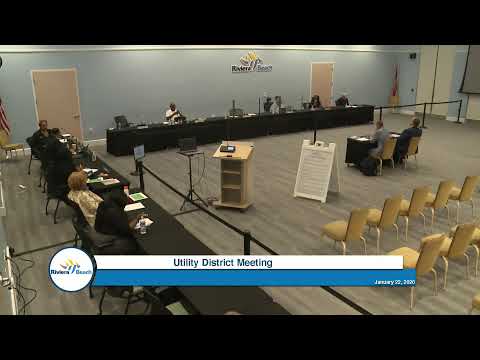
The Riviera Beach Utility Special District on Jan. 22 received multi‑part presentations on GMP 5, a $280,418,404.52 guaranteed‑maximum‑price proposal for a new membrane water‑treatment plant, but deferred a final vote until its Feb. 18 meeting while staff gathers comparative cost data.
Josh Neiman, the utility district’s executive director, opened the GMP 5 discussion by outlining the presentation sequence and saying the team had done extensive due diligence: “We are proud to bring GMP 5 to the commission for review and potential approval.” Consultants from Brown & Caldwell, the CDM‑Haskell joint venture and independent reviewers then walked the board through technical scope, costs and schedule.
Nigel Grace of Brown & Caldwell, the owner’s representative, described the plant as the hub of the city’s water‑modernization program. He told the board that direct construction bids totaled roughly $207 million, indirect costs (management, trailers, bonds, insurance, etc.) account for about 26% of the GMP, and contingency is slightly over 4%. Grace also said the design includes an ultrafiltration pretreatment building that was not in earlier plans; pilot testing showed raw‑water colloidal and microbial characteristics that require advanced pretreatment before nano‑filtration and reverse‑osmosis stages can function reliably.
The joint venture (CDM / Haskell) explained the ultrafiltration package adds roughly $25 million when building, pumps and associated systems are included. The JV reported broad market outreach (49 bid packages; 97 bids returned overall) but also acknowledged constrained contractor availability on large projects. Michael Hoisington of Haskell said the JV was committed to local participation goals and initially targeted a 15% local spend, prompting several board members to press for a 20% Riviera Beach‑first goal.
On schedule, staff and consultants said water could begin phasing into the distribution system in late 2028, with substantial completion targeted for November 2029 and final handover in 2030. Consultants warned the new federal and state focus on PFAS/PFOS requirements means delays could elevate compliance risk and potential fines if the city is not producing compliant water by the regulatory deadlines.
Finance director Randy Sherman and PFM adviser Sergio Masvidal presented financing options: municipal revenue bonds, the federal WIFIA loan program and the State Revolving Fund (SRF). They said SRF can carry principal forgiveness in certain cases and WIFIA can fund up to roughly 49% of project cost, but timelines differ (bonds 2–4 months, SRF ~6–12 months, WIFIA 12–24 months). Staff recommended a combination of bond financing and SRF in today’s market while aggressively pursuing grants and congressional appropriations to reduce ratepayer burden.
Several board members said they needed a clearer apples‑to‑apples cost comparison with recently built membrane plants before approving a contract of this scale. Sue Melamed, an independent engineer retained for a desktop comparison, presented a preliminary “back‑of‑the‑envelope” look that indicated Riviera Beach’s unit cost could be higher than some regional projects; she emphasized the analysis was rapid and recommended a more detailed breakdown with municipal cost data.
Public comment included both appeals to approve the project quickly and urgent pleas about affordability for seniors and low‑income residents. One long‑standing resident told the board she had been fighting for clean water for decades and urged the board to act.
After extended discussion, the board voted unanimously to postpone formal approval of GMP 5 to its Feb. 18, 2026 Utility District meeting and directed staff to pursue comparative cost data, richer documentation of alternatives (the so‑called "off‑ramp") and financing scenarios before the next vote. The postponement keeps both the negotiated GMP and the option to move toward a public solicitation on the table pending further information.
What’s next: staff and the owner's rep will attempt to obtain detailed cost breakdowns from comparable projects, assemble the requested comparisons and update the board in writing prior to Feb. 18. Meanwhile, staff will continue grant pursuit (SRF, direct congressional appropriations) and prepare bond‑structuring options so the district can mobilize quickly if the board approves the GMP.