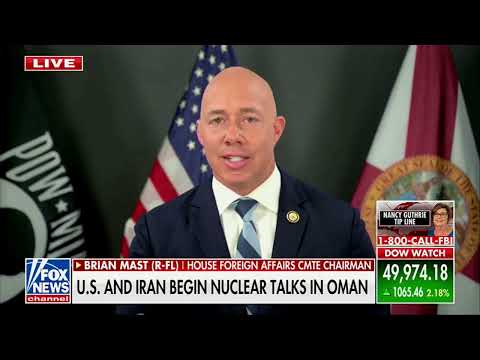
Rep. Brian Masti: U.S. presses Iran in talks; military force remains an option
Loading...
Summary
Rep. Brian Masti, chairman of the House Foreign Affairs Committee, told a broadcast interview that Washington is holding an ultimatum in talks with Iran, warned of recent Iranian drone and maritime activity, and said the U.S. is keeping military options on the table while stressing the need for post-operation planning.
Rep. Brian Masti, chairman of the House Foreign Affairs Committee, said in a broadcast interview that the United States is keeping strong pressure on Iran amid recent talks and that military force remains an option. "Conversation number 1, but if it takes combat to end threats against The United States Of America, then that's acceptable too," Masti said.
The host opened the segment by quoting Iranian official Abbas Araghchi as saying the recent talks "were a good start" but that continuation depends on consultations in respective capitals and on deciding "how to proceed regarding the very principle of continuing the negotiations." The host asked whether Iran will negotiate face-to-face and then resume hostile activities; Masti said he sees "two different conversations"—one he described as the U.S. position, demanding Iran stop being a threat to the U.S. and its allies, and another in which Iran is deciding what level of threat it will retain.
Masti pointed to recent incidents at sea and by drone as evidence Iran continues provocative actions. He said Iran has sent "Shaheed attack drones, 1 way attack drones to US Navy vessels carrying about a 100 pound explosive payload," and has used ships to harass United States merchant marine vessels. He also warned about Iran advancing ballistic-missile capabilities that he said could extend reach beyond regional targets.
The interview included a clip of President Trump saying Iran's supreme leader "should be very worried" and warning, "you do that, we're gonna do very bad things to you." The host also read a statement from Gen. Jack Keane arguing that negotiating with Iran "throws them a lifeline" and that the moment presented a chance to "take this regime down." Masti acknowledged those perspectives but emphasized planning concerns for any operation: "Nothing happens until every trigger is met," he said, listing considerations such as post-regime planning, suitable weather, and reliably locating the Ayatollah and those colocated with him so that "day 1 after any change in Iran results in a better day."
The host suggested Israel's intelligence service, the Mossad, likely knows the Ayatollah's location; Masti agreed with that characterization. The interview ended after a brief exchange.
The interview recorded a mix of public statements, policy stances and cited incidents; several claims (including the description of drone attacks and their explosive payload) were presented by Rep. Masti and were not independently corroborated during the segment. The discussion emphasized both the administration's stated willingness to use force if necessary and senior commentators' calls for regime removal, while Masti stressed the operational and political "triggers" that would need to be met before any military action.