Council hears wide-ranging water and utilities briefing as staff seeks direction on multimillion-dollar projects
Loading...
Summary
Staff briefed council on water projects including a reclaimed-water Cromwell line (congressional earmark ~$2.96M), an aquifer storage feasibility study (~$58.8M estimate), advanced metering deployment (AMI, ~$5.75M; meters installed), and a required wastewater treatment expansion (projected ~$210M). Council asked for ROI, eminent-domain flags and clearer funding plans.
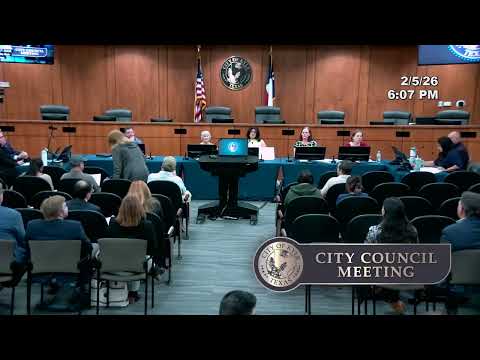
City staff used the Feb. 5 special meeting to present multiple utility projects and to ask the council for direction and further study.
Amber Smyth and utility staff summarized current and planned work: a Cromwell reclaimed-water line extending from the Plum Creek area toward Heroes Memorial Park and the Sportsplex fields (earmarked congressional funding ~$2.96 million; staff projected broader project costs could approach tens of millions), an Alliance Water expansion to roughly 2.73 million gallons per day (design under way), and a feasibility study for aquifer storage and recovery with an order-of-magnitude estimate of about $58,800,000.
Staff reported the city is deploying advanced metering infrastructure (AMI) to enable two-way, near-real-time communications with customer meters; staff said the meter installation is substantially complete and estimated total AMI project costs of about $5,750,000 with reported operational savings already captured. The wastewater treatment plant expansion to increase capacity up to 9 MGD (completed in phases) is under construction with an estimated total project cost near $210,000,000 and is required to maintain compliance with TCEQ regulations.
Council members asked staff for more detailed business cases, the amount of take-or-pay water contracts the city has underutilized historically (to analyze the aquifer-storage ROI), and any eminent-domain or property-acquisition implications for the Cromwell line and other projects. Staff agreed to return with more detailed feasibility, financing and cost-to-date information before further obligations.
Why it matters: These projects have large capital costs and long-term rate and service implications. The wastewater plant expansion is regulatory-driven; other projects aim to improve supply reliability and conservation but would shape future rate-setting or CIP plans.
What's next: Staff will return with feasibility studies, ROI analyses, legal flags (including eminent-domain needs), and clearer funding scenarios for council consideration. No final approvals or rate changes occurred at the Feb. 5 meeting.