
Committee advances generative AI AR after community concerns over K–5 use and opt‑out
Get AI-powered insights, summaries, and transcripts
Subscribe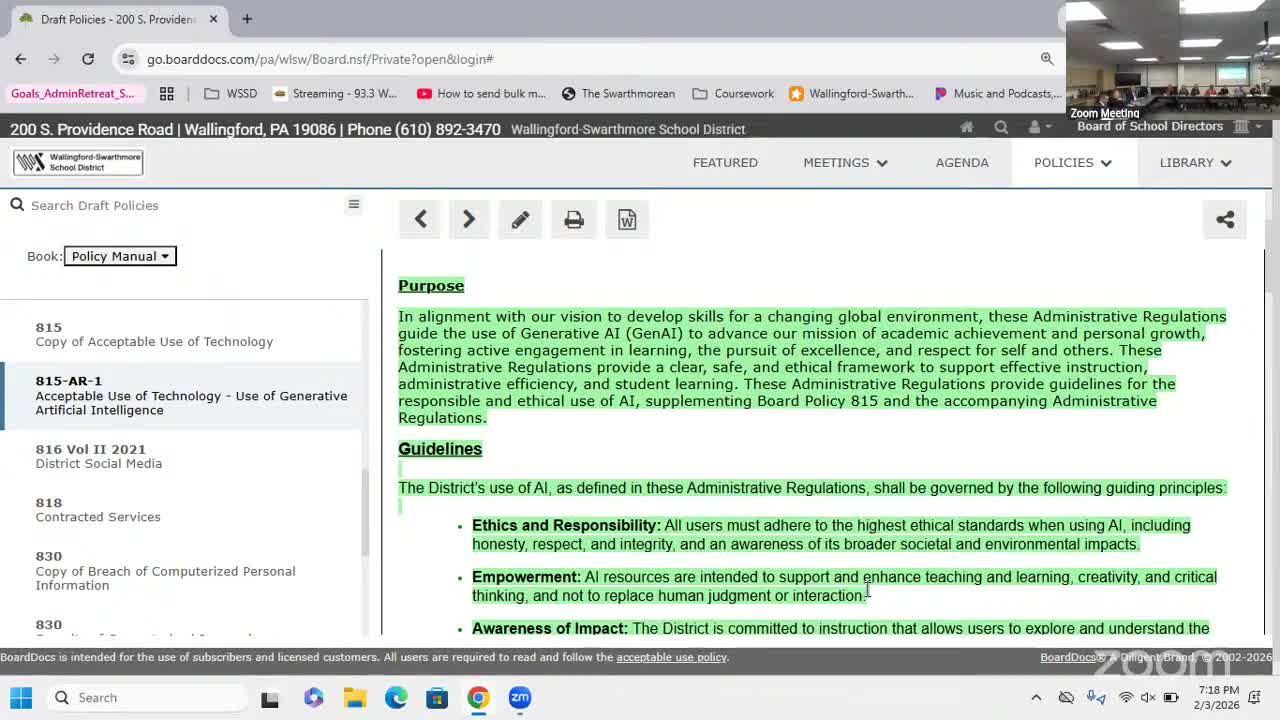
Summary
The committee reviewed AR 08:15, the district's guidance on generative AI: it sets vetting, training and disciplinary procedures and will be paired with grade‑level implementation guidelines. Community members urged a K–5 ban and a public registry of approved tools; administrators said vetting (FERPA/COPPA) and phased rollout will follow.
Wallingford‑Swarthmore School District committee members and community participants spent the latter half of the meeting reviewing AR 08:15, an administrative regulation that would govern how teachers and students may use generative artificial intelligence in district classrooms.
Speaker 5, who presented the regulation, said the AR is the product of months of work — teacher book studies, staff and student surveys, leadership meetings and a community forum — and is intended to provide guardrails for classroom use and a path for teacher training. "The book was AI for Educators, by Matt Miller," Speaker 5 said when describing the development process.
In public comment, Alex Beckert, a community member, urged caution and proposed three specific changes: require independent peer‑reviewed evidence of efficacy before approving tools; implement a ban on AI for elementary grades; and publish a public registry of every approved AI tool with a formal opt‑out for families. "I'm recommending that the district implement a no AI for elementary school," Beckert said.
Administrators and other board members responded that the AR is intended as an overarching framework and that detailed, grade‑by‑grade implementation guidance will spell out appropriate classroom uses. Speaker 9, an administrator responsible for implementation, said vetted tools will be reviewed for privacy protections and evidence: "Anything that we use is going to be something that we've really well vetted and it's going to be kind of a closed system."
Other points in the session included:
- Discipline and academic integrity: the AR adapts consequence language from existing student handbooks and the acceptable use policy; the district said consequences may include a zero on an assignment or progressive disciplinary measures for misuse.
- Privacy and vendor review: administrators said any tool will be reviewed for FERPA and COPPA compliance and that the solicitor's office will review contracts requiring signatures.
- Equity and access: board members raised concerns about exacerbating access gaps and requested guidance on how use of AI would not deepen existing inequities.
The committee did not vote to adopt the AR as a final policy but asked administrators to publish clearer implementation guidelines that specify whether and how generative AI will be used at different grade levels, how parents will be notified, and how families can opt out. The committee is expected to return a revised AR and associated classroom guidance to the board for consideration; the next committee meeting is scheduled for March 3.
The discussion shows the district is moving from principle to practice: the AR sets guardrails and a review process, while grade‑level guidance and communication strategies remain to be finalized.