Get Full Government Meeting Transcripts, Videos, & Alerts Forever!
Get email alerts on the Community Redevelopment topic
No spam. Unsubscribe anytime.
Redevelopment expert urges Pensacola CRAs to stick to plans, treat increment revenue carefully
Summary
Jeff Burton, a Florida redevelopment practitioner, told Pensacola advisory-board members that CRAs must follow their redevelopment plans, that CRA funds are increment revenue created by private investment (not direct taxes), and that incentives should be structured to be self-funded and documented to survive audits.
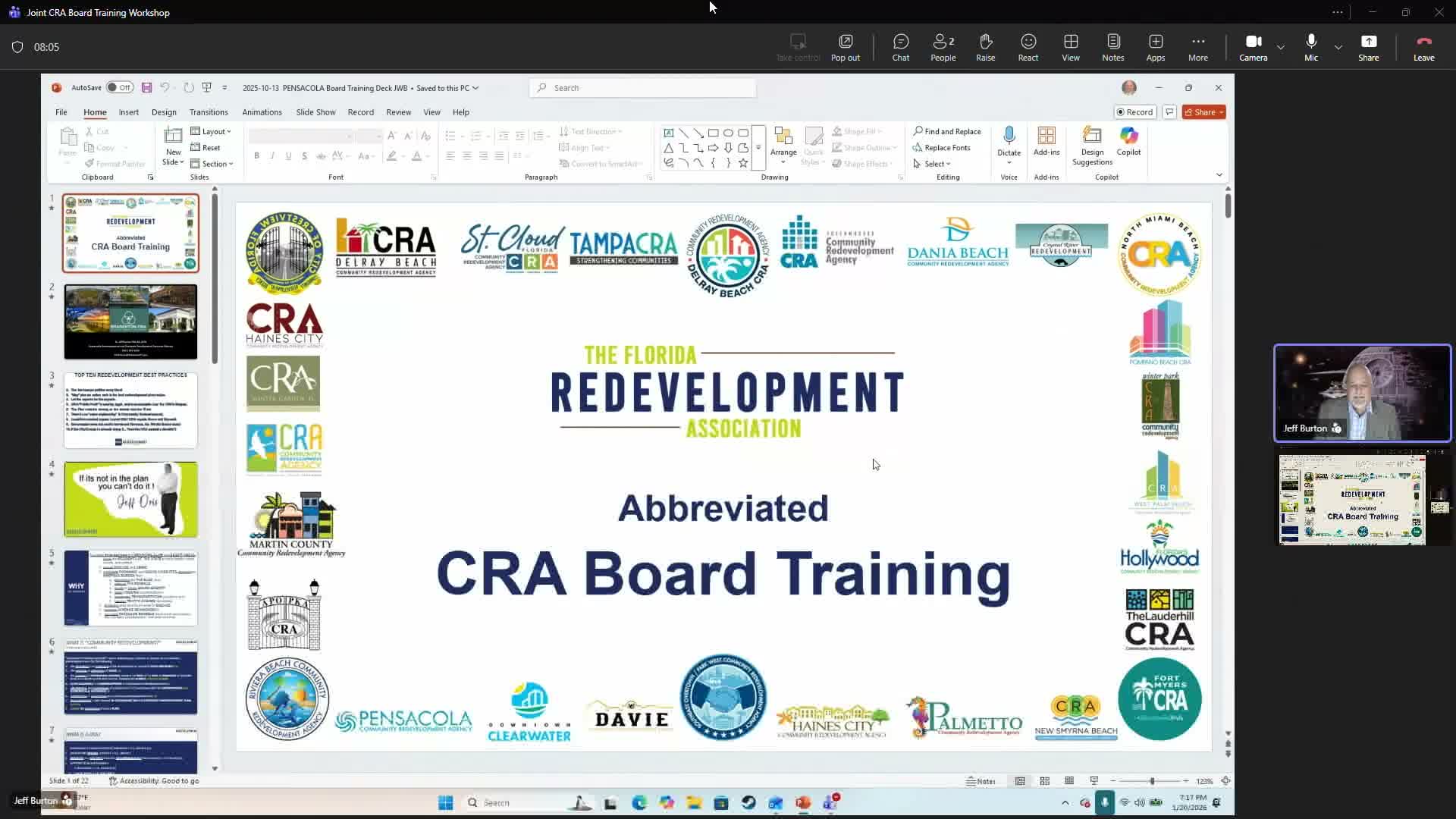
At a joint Pensacola redevelopment advisory-board meeting, redevelopment practitioner Jeff Burton delivered an extended training on Community Redevelopment Agencies (CRAs), focusing on the legal framework, funding mechanics and best practices for incentive and project design.
Burton told attendees that CRAs are special, flexible public entities created to address blight and to partner with the private sector to generate "increment revenue." He repeatedly emphasized a central rule for CRA governance: "If it's not in your plan, you cannot do it." The presenter said the redevelopment plan is the primary constraint on allowable CRA activity and urged board members to consult counsel and to document decisions and public meetings.
On funding, Burton clarified that the money CRAs spend is legally characterized as increment revenue derived from private-sector investment, not a direct tax levy. He cautioned against confusing terminology: while many practitioners say "TIF," he said CRAs should correctly reference "increment revenue" and structure incentives so they are tied to actual private investment rather than paid entirely up front.
Burton outlined statutory powers and limits under Florida law (he repeatedly cited the redevelopment statute and related special-district provisions): CRAs may acquire, improve and dispose of property at "fair value," contract for redevelopment work, prepare and advertise requests for proposals, and invest or pledge CRA funds. He warned CRAs not to use eminent domain for redevelopment purposes and noted state audit risk when CRAs spend on items not in their approved plans.
He gave operational guidance: prefer pay-as-you-go incentives that are self-funded by private investment, require annual reporting for community policing or other funded programs, invest in staff training (FRA certification, CDFA, IEDC), involve advisory boards in early engagement to build public support, and use interlocal agreements when commingling city, county and CRA funds.
Burton also provided statewide context: as of 2024, he said, there were roughly 212 CRA agencies and 287 CRA areas in Florida, and earlier research suggested statewide increment revenue approaches or exceeds $1 billion annually. He encouraged Pensacola representatives to participate in Florida Redevelopment Association activities and noted an FRA conference scheduled in October at the Sunseeker Hotel in Punta Gorda.
Attendees asked technical questions about incentives and terminology; Burton offered to provide sample incentive definitions and the slide deck for follow-up. The meeting closed with organizers promising to distribute presentation materials and contact information.