Get Full Government Meeting Transcripts, Videos, & Alerts Forever!
Get email alerts on the Governance Reform topic
No spam. Unsubscribe anytime.
Nantucket commission advances Article 74 to broaden regional seats; committee urges merger with citizen petition
Summary
The Nantucket Planning and Economic Development Commission (MPEDC/NPEDC) briefed the Finance Committee on Article 74, proposing sector-based appointed seats and name changes to broaden participation; members urged negotiators to reconcile Article 74 with a similar citizen petition (Article 75) before town meeting.
The Finance Committee on Feb. 5 heard the Nantucket Planning and Economic Development Commission present Article 74, a proposal to recast the body as a broader regional commission with more appointed "sector" seats and fewer elected planning-board representatives.
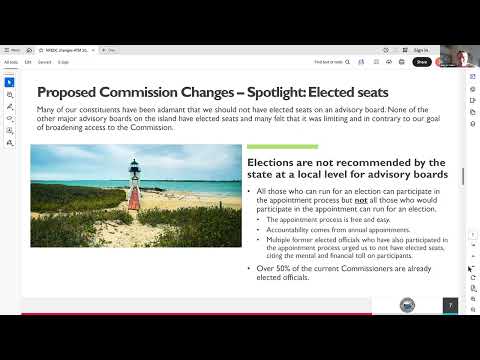
The commission's vice chair, Mike Mizzarelli, told the committee the change aims to "broaden access to the commission for people in the community of Nantucket and emphasizing the regional piece." Abby, a staff member who presented slides, said the plan would reduce planning-board representation from five to three, add sector seats (land bank, conservation, housing-sector appointed by the Affordable Housing Trust, a CLG/historic-preservation seat) and convert three at-large seats to appointments made by the county commissioners.
Committee members and commissioners described five years of work on the draft and said the commission voted 8–3 to forward its version to the May town meeting warrant. Several members said state guidance and the commission's research favor appointment for advisory regional planning bodies. "Based on the research we had and recommendation from the state... appointed commissioners make more sense," Abby said.
The primary friction between Article 74 and a separate citizen petition, Article 75, concerned whether seats should be elected or appointed and whether to add term limits. John Kitchener told the committee there is "almost no daylight between these two articles" and urged both sides to find a compromise. Multiple Finance Committee members warned that two similar articles on the same subject could confuse town meeting voters and lengthen proceedings.
Committee members pressed on operational details: residency rules (defined to include one’s name on the street list or registered voter), term lengths (most seats proposed as one year, at-large seats three years), and how sector appointments would be filled if the appointing authority had no candidate. Commissioners said sector appointments were intended to broaden the pool by allowing appointing authorities to name qualified representatives from a sector when an official board-member will not serve.
Several committee members recommended a facilitated session at the commission’s upcoming Feb. 17 meeting to try to resolve the elected-vs.-appointed impasse. The commission confirmed the Feb. 17 meeting is scheduled to continue deliberations; Mizzarelli said the commission remains committed to presenting a unified proposal if possible.
If the two proposals cannot be reconciled before the warrant is finalized, the Finance Committee emphasized that the prospect of having both Article 74 and Article 75 on the same warrant could lead to voter confusion at town meeting.
The Finance Committee did not take a final recommendation on Article 74 at the Feb. 5 meeting; the committee asked the commission to return after its Feb. 17 discussions with a clearer, consolidated proposal.