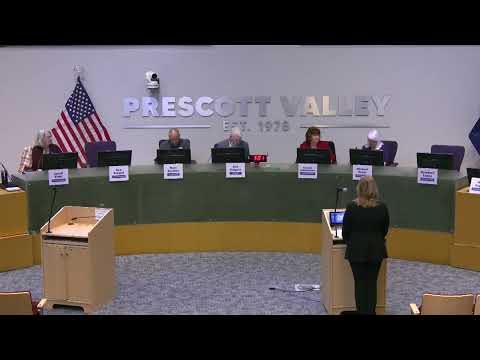
Prescott Valley staff outline plan to shift town health coverage to self-funded model
Loading...
Summary
Town staff presented details on moving the employee health plan from fully insured to self-funded, noting potential long-term cost control and the need for year-one reserves; staff will return with cost modeling and a recommendation, with no vote taken.
Speaker 1 (presenter) told the Prescott Valley Town Council that the primary advantage of shifting to a self-funded health plan is "plan flexibility," giving the town more control over benefits and the ability to deploy programs aimed at attraction, retention and cost management. "The biggest advantage for you is plan flexibility," the presenter said.
The presenter cautioned that self-funding does not remove underlying risk. "When you move from fully insured to self funding, you haven't fundamentally done anything different about your risk," Speaker 1 said, and advised council members not to expect immediate market savings. He said the goal is better data and control so the town can manage costs over a multi-year horizon rather than assume near-term reductions.
Staff outlined two technical protections the town would use if it proceeds: individual and aggregate stop-loss insurance to limit catastrophic exposure, and predictive modeling to smooth funding across fluctuating claims. The presenter said year-one funding will likely require building reserves and warned that the initial budget impact could be higher "to make sure that you have the reserves should there be some high claims in that first year." He added that good claims years can be offset by using reserves in bad years.
On pharmacy benefits, staff asserted that greater transparency and pass-through pricing would allow rebate dollars that today go to carriers to instead offset the town's plan costs. "All of those rebate dollars ... go back to the carrier today. But those dollars will come back to you and you'll be able to use those dollars to offset your risk," Speaker 1 said.
Staff said the town plans to retain the existing provider network while engaging a third-party administrator so employees see minimal disruption. Speaker 4 (staff) explained the approach was to "engage a third party administrator to continue with our current network with United," and said stop-loss and renewal rates for both self-funded and fully insured options will be modeled over the coming weeks. If the council agrees to proceed, staff said they would seek to have a third-party administrator in place before open enrollment in May for a self-insured plan year beginning July 1.
During questions, a council member (Speaker 3) asked whether self-funding would cover liability or property. Staff clarified the proposal applies only to medical insurance and does not affect property, liability or workers' compensation, which are handled separately through the Arizona Municipal Risk Retention Pool.
On reserve funding, Speaker 5 (staff) said, "we plan to come to council with a recommendation for seed money to do the reserve. And then the rest, we can actually build into the premium." She added staff did not yet have sufficient detail to choose a single approach and will present multiple options.
Speaker 6 (staff) clarified administration: the town will not be making clinical claims decisions and would work with an administrator such as UMR (a UnitedHealthcare subsidiary) that serves self-insured clients. "We're not wedded to UnitedHealthcare," Speaker 6 said, noting the town could later put administration out to bid among vendors such as Blue Cross or Aetna.
Speaker 5 explained two options for holding reserves: an internal service fund within the town's financials, which could be loaned between funds, or a Section 115 trust, which would restrict the allocated money to the medical plan. She described trade-offs in flexibility and asset protection and said staff will outline pros and cons in their recommendation.
No motion or formal vote occurred. Staff will return to the council with modeled cost comparisons, stop-loss pricing, and a recommendation on whether to proceed and how to seed reserves; if the council approves later, implementation work would aim to align with May open enrollment and a July 1 plan year start.