Get Full Government Meeting Transcripts, Videos, & Alerts Forever!
Get email alerts on the Criminal Procedure topic
No spam. Unsubscribe anytime.
Defense urges suppression of Lovelace statements, citing prolonged custody and equivocal counsel request
Summary
At oral argument, defense attorney Stephanie Ritchie Miles asked an appellate panel to reverse denial of Mr. Lovelace’s motion to suppress, arguing prolonged custody, repeated complaints he was 'cold,' and an equivocal 1:01 a.m. request for a lawyer undermined voluntariness and required suppression of later statements. The state countered that the request was equivocal and any error would be harmless.
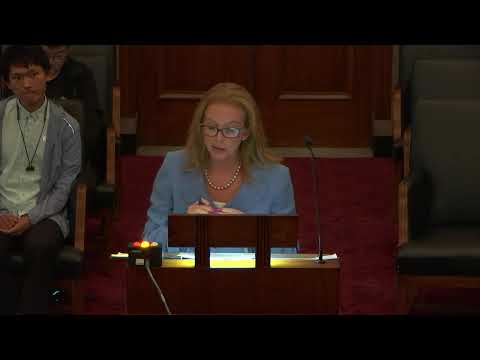
Attorney Stephanie Ritchie Miles, arguing for the defense, asked an appellate panel to reverse the denial of Mr. Lovelace’s pretrial motion to suppress statements obtained during a prolonged custodial interrogation.
Miles told the court that Mr. Lovelace arrived in custody at about 8:00 p.m., was cuffed to the floor, signed a Miranda waiver shortly after arrival, and was questioned intermittently beginning around 8:36 p.m. She said the record shows the defendant repeatedly told officers “I’m cold” (about six times) and made multiple bathroom requests during roughly four hours of intermittent questioning, which she argued is relevant to whether his statements were voluntary.
“Because he was cuffed to the floor and repeatedly complaining he was cold,” Miles told the panel, those physical conditions and the lengthy interrogation should factor into the voluntariness analysis. She also said officers made inducements during questioning — for example, statements suggesting they would protect the defendant’s family or not charge others — which, combined with the prolonged custody and defendant’s state of distress, support suppression.
Miles further argued that at approximately 1:01 a.m. Mr. Lovelace asked, “Can I just have my lawyer with me?” and that the officer’s reply, recorded as “That’s up to you,” signaled to both parties that the defendant had invoked his right to counsel. Counsel said agents paused, packed up, and left; the defendant was later transported and booked at about 5:26 a.m. and then brought back for a subsequent interview at about 11:35 a.m. Miles told the court the later interview occurred after the asserted invocation and should therefore be suppressed.
Representing the state, Liz Evan disputed that the 1:01 a.m. remark was an unequivocal invocation of the right to counsel. Evan said the defendant’s question came in the context of asking how he could “clear my name” and that agents responded and continued questioning for several minutes. “That’s up to you,” Evan said the agent replied, and the defendant did not press the point or insist on counsel at that time. The state contended the defendant continued voluntary discussion and that any later re-administration of Miranda rights before a mid‑morning ‘show‑and‑tell’ was captured on body‑worn camera and did not produce new substantive admissions.
The panel and counsel discussed controlling precedent cited by both sides. Judges and counsel referenced several appellate decisions (including Funk, Rizzo, Nash, Moseley, McKinney, and Crump) while probing whether a defendant’s equivocal request for counsel, subsequent pauses, breaks in questioning, or relocation to another facility require a formal re‑Mirandizing before further interrogation. The bench repeatedly framed the issue as a totality‑of‑circumstances inquiry: whether the defendant’s will was overcome or whether his remarks constituted an unequivocal invocation of the right to counsel.
Counsel conceded the record is complex: the defense emphasized the defendant’s repeated complaints about being cold, intermittent periods of questioning and silence, and alleged inducements by officers; the state emphasized that substantial admissions began around 3:00 a.m. and that a later, videotaped re‑administration occurred before the mid‑morning field interview.
The court recessed for lunch with no immediate ruling on suppression. The panel’s decision will determine whether portions of Mr. Lovelace’s statements may be admitted at trial and whether the claimed invocation of counsel and the alleged diminution of Miranda protections require suppression.