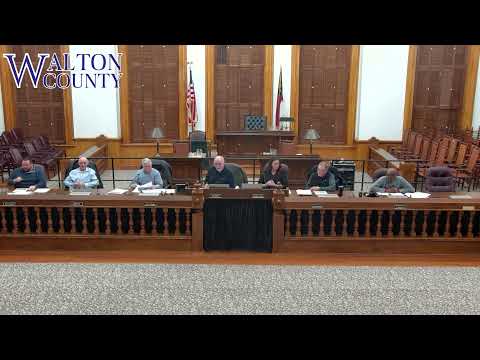
Planning commission recommends conditional use for new Walton County church with conditions
Loading...
Summary
Walton County Planning Commission voted Feb. 5 to recommend approval of a conditional-use permit for Holy Trinity Church’s proposed 15.9-acre site on Youth Monroe Road, with five conditions including a 25-foot planted buffer, prohibition of direct Joanne Drive access, and a six-year limit on use of an existing barn.
The Walton County Planning Commission voted Feb. 5 to recommend approval of a conditional-use permit allowing Holy Trinity Church to locate a place of worship and community programs on a 15.9-acre site at 3601 Youth Monroe Road. The commission attached five conditions, including a prohibition on direct access to Joanne Drive, a 25-foot planted buffer along specified neighboring lots, a six-year limit on using an existing barn as the primary facility, a ban on senior-housing or assisted-living uses, and inward-facing lighting that meets county standards.
The church’s representative, who identified himself as priest Fazir Manchilogwadeh, told the commission he intends the site to serve worship and community education programs and said the congregation would first repurpose an on-site barn and later build a permanent facility in phases. "We have parking and traffic management plans because we use only Sundays," Manchilogwadeh said, and he agreed to conditions on temporary barn use and access. He also said the group plans to welcome neighbors and collaborate with existing local churches.
Neighbors raised several concerns during the public-comment period. Dana Dance said residents worry development will depress property values and increase traffic, lighting and noise. "Property values will plummet," Dance said, and expressed skepticism that weekend-only use was the full plan. Dr. John Carr, speaking as a nearby resident and treasurer of a local association, raised safety concerns related to the nearby airport and suggested a single-story limit; other neighbors cited standing water and stormwater/septic capacity concerns.
Commissioners pressed the applicant on site access, buffers and the timeline for converting the barn. Commissioner (speaker 4) proposed the five-condition motion and explained details including the species mix for the planted buffer and that utilization of the barn as the primary facility would be limited to six years unless extended by the Board of Commissioners. That motion passed by voice vote; the Planning Commission’s recommendation will go to the Board of Commissioners for final action on March 3.
The decision distinguishes between discussion, conditions and formal action: the commission’s vote was a recommendation only; final approval rests with the county commission. The conditions are specific and procedural — for example, the barn conversion requires all jurisdictional permits prior to operation and any extension of the six-year limit must be approved by the Board of Commissioners — and they address many neighbor concerns about access, buffering and lighting. The commission did not adopt any prohibition on the educational activities the applicant described; commissioners stated that such tutoring and classes would be permitted within the approved "place of worship" use under the conditions adopted.
The Board of Commissioners is scheduled to consider the Planning Commission’s recommendation on March 3.