
Alabama Supreme Court hears dispute over interplay of Habitual Felony Offender Act and pharmacy-robbery parole rule
Get AI-powered insights, summaries, and transcripts
Subscribe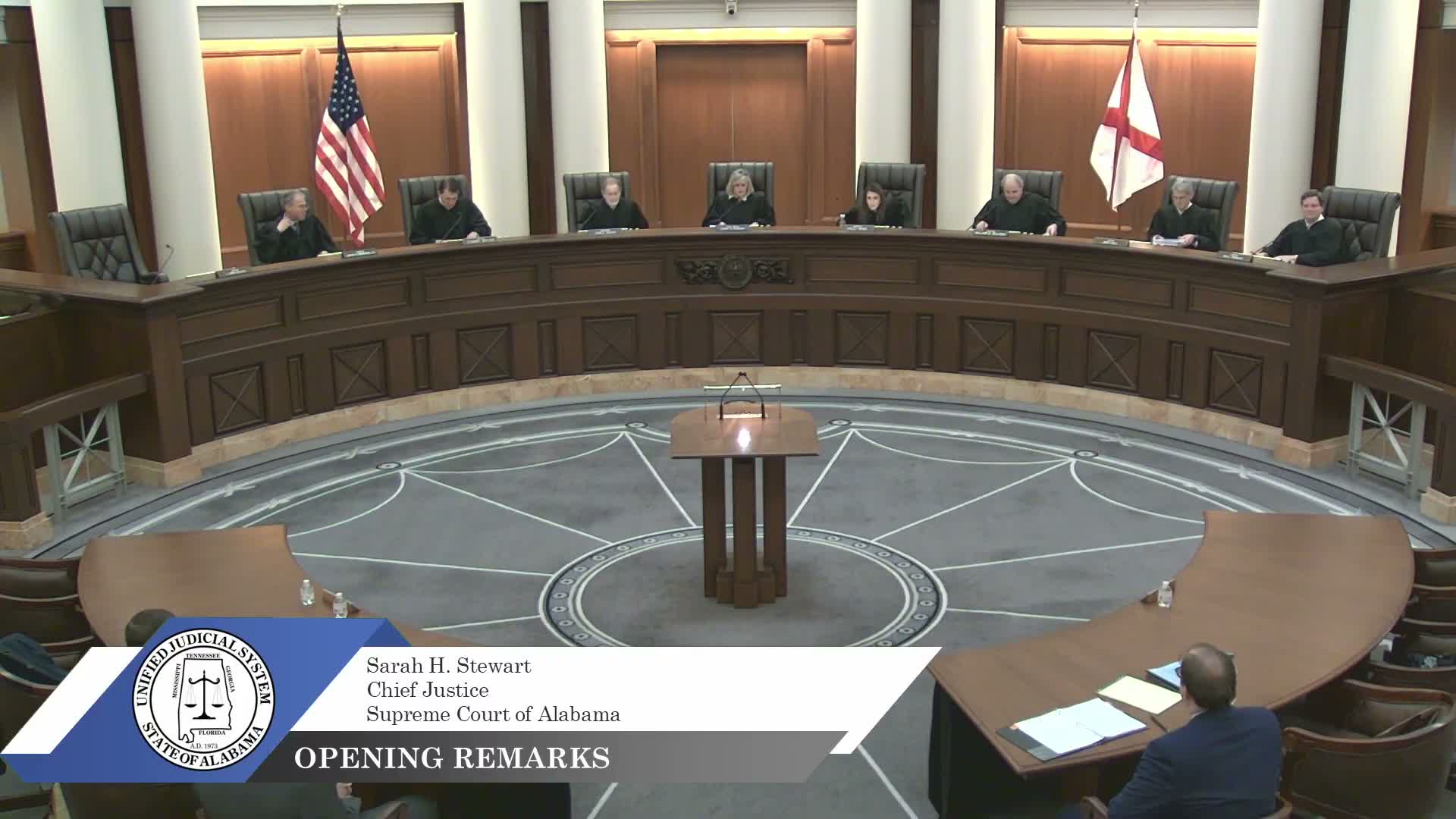
Summary
In oral arguments in Ex parte Antonio Spencer, attorneys disputed whether the Habitual Felony Offender Act required trial courts to choose parole eligibility for life sentences or whether the pharmacy-robbery statute bars parole for certain life terms; the court took the case under submission and a justice was recused.
MONTGOMERY, Ala. — The Alabama Supreme Court on Wednesday heard arguments in Ex parte Antonio Spencer over whether the Habitual Felony Offender Act (HFOA) left trial judges free to decide whether a life sentence should include parole eligibility or whether the pharmacy-robbery statute bars parole in some life sentences.
Chris Young Peter, counsel for petitioner Antonio Spencer, told the court the trial judge failed to exercise the discretion the HFOA requires when imposing life. "The trial court did not exercise the mandatory discretion that is required under the Habitual Offender Act," Young Peter argued, urging reversal and resentencing.
Young Peter said there was no dispute the HFOA applied but that the pharmacy-robbery penalty statute’s subsection (a) — which sets a 10-to-99-year baseline and states such a sentence is "not parole eligible" — does not speak to parole eligibility for a life sentence. He told the justices the statutes "can coexist": the pharmacy statute establishes a baseline term of years while the HFOA provides an enhanced life range and requires the trial court to choose whether that life sentence carries parole eligibility.
Responding for the State, George Muirhead told the court the two statutes should be read harmoniously and that the HFOA operates as an enhancement of the baseline pharmacy penalty. "The HFOA then enhances the baseline penalty," Muirhead said, arguing the statutes’ text and longstanding interpretive principles support affirming the sentence. He asked the court to uphold the life-without-parole sentence on the record, describing Spencer as a "violent repeat offender."
Justices pressed both sides with hypotheticals and statutory-text questions. One justice asked whether the pharmacy statute’s language that someone "shall be ineligible for consideration for parole" is a direction to the parole board (an executive-branch decision) rather than a sentencing instruction for the trial court; bench questioning repeatedly circled the practical effect of sentencing language and the separation-of-powers limits on what a trial court can order regarding parole.
Petitioner’s counsel noted that subsection (b) of the pharmacy statute imposes life only when the defendant has a prior pharmacy-robbery conviction, which Spencer did not have, and that the State had filed a notice of intent to invoke the HFOA at trial, making application of the HFOA operative in this case. The parties and the bench debated two interpretive frameworks — starting from the pharmacy statute and enhancing under the HFOA, or viewing the statutes as a "funnel" that increases penalties in steps — and whether reading the statutes harmoniously produces a practical "ping-pong" between provisions.
The bench also discussed precedent cited by the parties (including Goldsmith and Thomas in counsel’s argument) and whether those decisions govern the interplay between a specific penalty statute and a general enhancement statute. Counsel for Spencer asked the court to reverse and remand for resentencing; counsel for the State asked the court to affirm.
After the arguments the court took the case under submission. The court noted that Justice McColl was recused because he sat on the court below when the case was decided.
The Supreme Court of Alabama did not announce a decision from the bench; next steps will be a written opinion when the court issues it.