Get Full Government Meeting Transcripts, Videos, & Alerts Forever!
Get email alerts on the Hunting Regulation topic
No spam. Unsubscribe anytime.
Waseca County holds listening session as residents debate keeping shotgun-only deer zones or allowing rifles
Summary
The Waseca County Board hosted a public listening session where staff presented safety studies and dozens of residents weighed in on whether the county should adopt an ordinance to retain shotgun-only deer zones or allow centerfire rifles under a recent state law change.
WASECA COUNTY — The Waseca County Board convened an evening listening session led by Board Chair Dee Malter to gather public input on whether the county should implement a local ordinance to retain its shotgun-only deer hunting zone or allow centerfire rifles after a recent change in state law. "I'm Dee Malter. I'm the current board chair of the Waseca County board, and we are here tonight to listen and to learn," Malter told attendees.
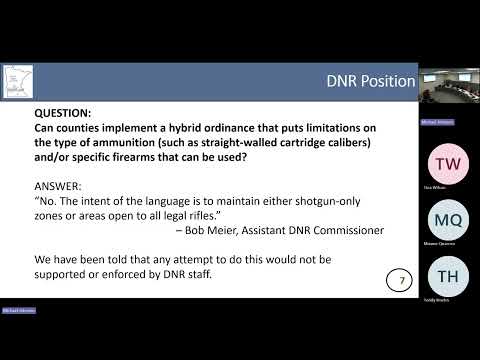
County staff summarized the legal background and research. A staff presenter identified only as Michael told the room the statute dates to 1942 and that the legislature's recent change allows counties to adopt ordinances that model the prior shotgun zone or take no action and let the state statute stand. Michael said the Minnesota Department of Natural Resources (DNR) has taken a neutral position and prefers counties avoid "patchwork solutions," and he noted the DNR moved a printing/notification deadline to May 5.
Michael summarized outside studies the county has reviewed. He cited a Pennsylvania legislative task-force report that examined trajectories and danger areas for shotgun slugs, muzzleloaders and centerfire rifles; reading from the report he said that under some "0 degree" firing-elevation scenarios the study found "given this firing condition, the shotgun is riskier than the rifle." He also summarized a recent ammo.com review of 2020–2025 hunting-accident data, noting the sites' headline findings that roughly 80% of hunting accidents trace to human error and that tree-stand incidents account for many injuries.
Public comment filled the remainder of the session. Several speakers urged the county to allow rifles, citing rising deer densities in some areas, declining hunter-license participation and the view that rifles can enable more ethical, longer-distance shots and make hunting easier for youth and seniors. Tony Hansen, a local resident, summarized DNR harvest data and told the board he was "pro rifle here." Several other speakers — including hunters who said they value longer seasons, private-landholders who pointed to landowners' ability to restrict firearms on their property, and certified hunter-education instructors — urged the board to consider season length, permit tools and hunter-education as ways to address population or safety issues without immediate ordinance change.
Opponents warned about safety in Waseca County's landscape of smaller parcels, river bottoms and line fences. Mark Shatsky and others said farm-country conditions make long rifle shots more consequential and said they preferred retaining shotgun-only restrictions or waiting to see what neighboring counties do before making a local policy change.
Several residents questioned the age and applicability of some safety studies and observed that modern slugs, muzzleloaders and rifles have evolved, which complicates direct comparisons. Others urged the board to weigh enforcement logistics and legal risk; a resident asked whether adopting a local ordinance would require DNR or local law-enforcement assistance to enforce it and warned that a new ordinance could prompt litigation.
On process and timing, staff said the board had placed a placeholder public hearing on its agenda for Feb. 3 with a potential follow-up on Feb. 17 to meet public-notice requirements; staff also said the DNR printing deadline for including county-specific rules in the DNR book is May 5. Malter and staff emphasized that not acting is itself a decision: letting the statute stand would allow rifles in the county until the board pursued a local ordinance.
The board made no formal decision at the listening session. Malter closed by thanking residents and saying the board will consider public input, neighboring counties' choices and the staff material before it takes up the issue at a future board meeting in February. "You have been able to see some of the information that we are getting in front of us, and I want you to know that we are listening and considering and trying to be wise about either making a decision or making no decision and allowing state statute to just stand," she said.