
United Hub proposes City Hall and Lake Bourne Park EV chargers with state and utility funding
Get AI-powered insights, summaries, and transcripts
Subscribe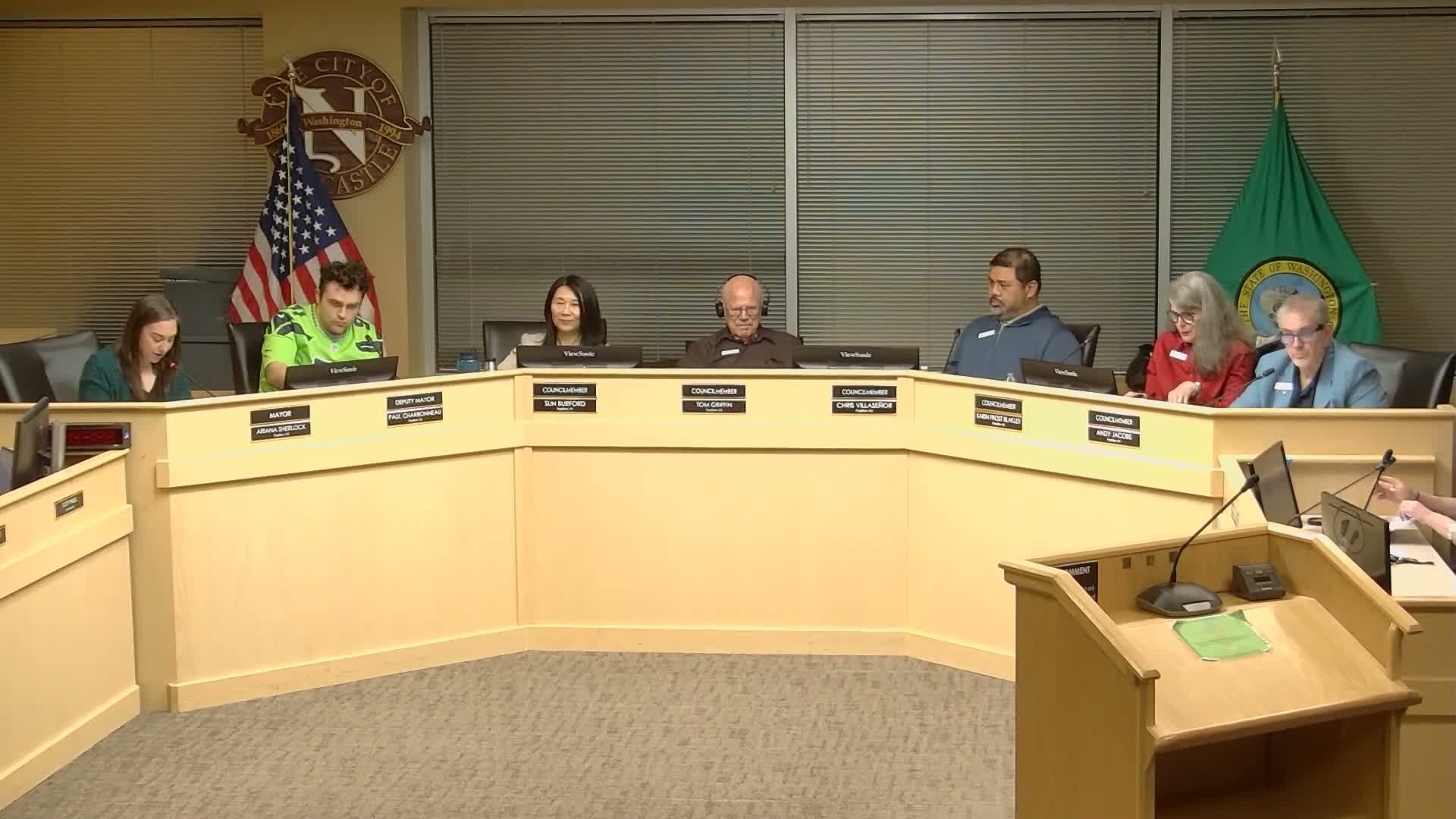
Summary
United Hub presented plans to install Level‑2 chargers at City Hall and fast chargers at Lake Bourne Park, proposing roughly $820,000–$870,000 in outside funding (state Department of Commerce, Puget Sound Energy) and seeking city coordination on installation details and limited in-kind trenching support.
A nonprofit, United Hub, asked the Newcastle City Council on Feb. 3 to consider two public EV-charging projects: four Level‑2 ports at City Hall and three dual-port 100‑kW fast chargers at Lake Bourne Park.
Thomas (Tom) Boydell of United Hub said the organization had packaged grant and utility support and estimated the combined project resources at about $870,000. He described committed funding including roughly $500,000 from the Washington State Department of Commerce for the Lake Bourne Park project and a proposed contribution from Puget Sound Energy. For City Hall, United Hub estimated a $47,000 project cost and said it had nearly $30,000 committed from the Department of Commerce and had requested an additional $16,000 from Puget Sound Energy.
Boydell outlined equipment, operations and timing: Level‑2 chargers at City Hall could be completed by September 2026 and the Lake Bourne Park fast‑charger project is targeted for 2027 pending transformer lead time. United Hub proposed to operate and maintain the stations for a four‑ to six‑year period under a license agreement, after which ownership could transfer to the city. Boydell said the organization intends to operate the chargers at breakeven and to place any excess revenues into a maintenance reserve; he also noted options to absorb modest cost overages without calling on the city.
Council members asked about utilization and equity. Council member Jacobs asked what percentage of residents own electric vehicles; Boydell said he had no precise Newcastle figure but cited regional growth and anecdotal local need. Questions about session length and cost led Boydell to explain that Level‑2 charging provides modest, longer-duration top-ups (useful for employees and visitors), while fast chargers deliver significant range in 30–40 minutes and were being sited for Lake Bourne Park to support events and park users.
City staff said detailed license agreements and cost‑sharing terms will return to council for approval; staff signaled the March 3 agenda as the likely earliest meeting to bring a final proposal. Council members expressed general enthusiasm and asked staff to refine site and procurement details before any city contribution was requested.
Next steps: staff will finalize license-agreement language, confirm any city in‑kind contributions (trenching support was proposed for the park) and return with the formal agreement and budget before construction begins.