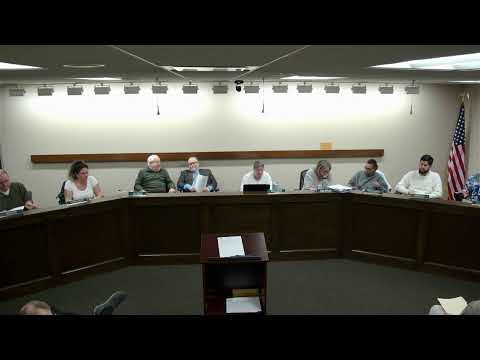
Council hears long developer presentation on D.R. Horton rezoning for 'Commercial Point Village'
Loading...
Summary
Developers from D.R. Horton presented a proposed rezoning from R-3 to Planned Residential District for about 21.9 acres that would allow a 160-unit townhome community. Council members pressed the developer on traffic, school capacity, buffers, parking and whether tax incentives would be sought.
D.R. Horton representatives told the Commercial Point Village Council they are seeking rezoning to permit a 160-unit planned residential development they described as an “attainable” townhome community. The ordinance under consideration would change roughly 21.92 acres from R‑3 to PRD and adopt preliminary plans and development standards.
Jack Martino, identified as division president for D.R. Horton, said the plan includes a 172‑foot buffer along the north boundary with 5–6 foot mounding, roughly a half‑mile of walking trails, a pavilion and tot lot, private streets maintained by an HOA, and design standards aimed at higher‑quality attached housing. He said unit pricing is projected in the neighborhood of $380,000–$390,000 and that a financing package the builder would offer (a 30‑year fixed mortgage at about 4.99 percent, he said) is intended to make monthly payments affordable to households with roughly $85,000–$90,000 in combined annual income.
The developer also presented traffic mitigation measures developed in coordination with ODOT and village engineers. Those include a required northbound left‑turn lane and an approximately 250‑foot southbound right‑turn lane at the primary entrance; the developer said a previously proposed right‑in/right‑out was reduced to emergency access only. The engineer said the traffic counts did not warrant a signal at the entrance in the current study.
Council members pushed back on a number of points. Several said the proposed density—about double the number of units that could be built under the parcel’s current R‑3 zoning—could increase school enrollment and create parking and congestion concerns for adjacent neighborhoods. One council member asked whether the developer would later seek tax incentives (a CRA) to support lower monthly payments; D.R. Horton representatives said the price point they presented is not contingent on a tax abatement but that an incentive could reduce buyers’ payments and broaden the pool of qualified households.
Bill Scaler, identified in the presentation as a property owner with long involvement in local development, urged council members to consider the developer’s track record and said the project would be built to higher standards than a base R‑3 subdivision.
No final vote on the rezoning was taken during the presentation; the ordinance remains at second reading and councilmembers asked the developer to return with additional detail at the third reading, including specific landscape/brick percentage commitments and final engineering plans.