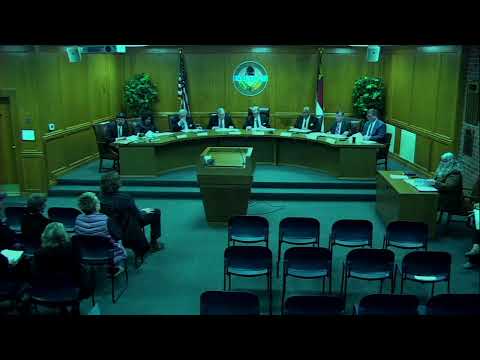
Clinton council denies special-use request for 135-foot cell tower near two schools after health and safety concerns
Loading...
Summary
After hours of testimony from experts and residents, the Clinton City Council denied a special-use permit for a 135-foot cell tower on Borken Bridal Road, citing failure to meet required standards; neighbors raised health, notification and aviation concerns while the applicant presented FAA clearance and an appraisal study.
The Clinton City Council voted to deny a special-use request for a 135-foot cell tower on Borken Bridal Road after residents, an appraiser and company representatives presented competing evidence about safety, property values and aviation impacts.
The hearing opened with planning staff describing the 64-acre site and the applicant, Southern Towers, and noting the company supplied an FAA determination of no hazard to air navigation. Applicant representatives said the site fell inside the carrier’s search ring and met ordinance requirements; an appraiser retained by the applicant testified the tower would not "substantially injure the value of adjacent or abutting properties." Council members questioned the comparables used in that analysis.
Residents who live near the proposed site and community members urged denial. "I'm here to oppose the tower being put at that location," said Susan Brewington, a Sampson County resident and health-care worker, who said she feared 24/7 exposure for children who attend the nearby Sampson Middle School and Clinton High School. Several speakers described inconsistent notice to neighbors and a zoning sign they said was difficult to read from the road.
Southern Towers representatives said the tower would be scaled to meet local height restrictions, would have medium-intensity lighting (white by day, red at night) and that lighting outages are electronically monitored; they said a NOTAM (notice to airmen) would be issued if lights fail. "We file a NOTAM first thing," a company representative said when asked about lighting outages.
Michael Berkowitz, an appraiser who provided a market-impact analysis for the applicant, testified that his quantitative review of comparable sales did not show a substantial negative effect on nearby property values. Council members pressed him about differences between sites he studied and the Clinton location.
Physician Ray Thomas urged the council to apply caution in siting infrastructure near schools: "Once you shoot your shot, you can't pull it back," he said, arguing that long-term effects on children cannot be ethically tested and that prudence counsels denial.
After hearing testimony and questioning witnesses, council members ran through the special-use standards. A motion that the application did not meet the first standard carried; council members then similarly found the application did not meet standards related to public health and safety, property-value impacts, harmony with the surrounding area and conformity with official plans. The council denied the application.
The council’s written record will reflect the findings of fact and the votes taken on each standard; the denial means the applicant will have to revise the siting plan or pursue another site if it seeks future approval. The hearing included multiple requests from residents for independent post-installation RF (radiofrequency) monitoring and for clearer public notice if the applicant re-files or proposes modifications.