
Prince George's County task force finalizes ER wait-time report, proposes eight primary actions
Get AI-powered insights, summaries, and transcripts
Sign Up Free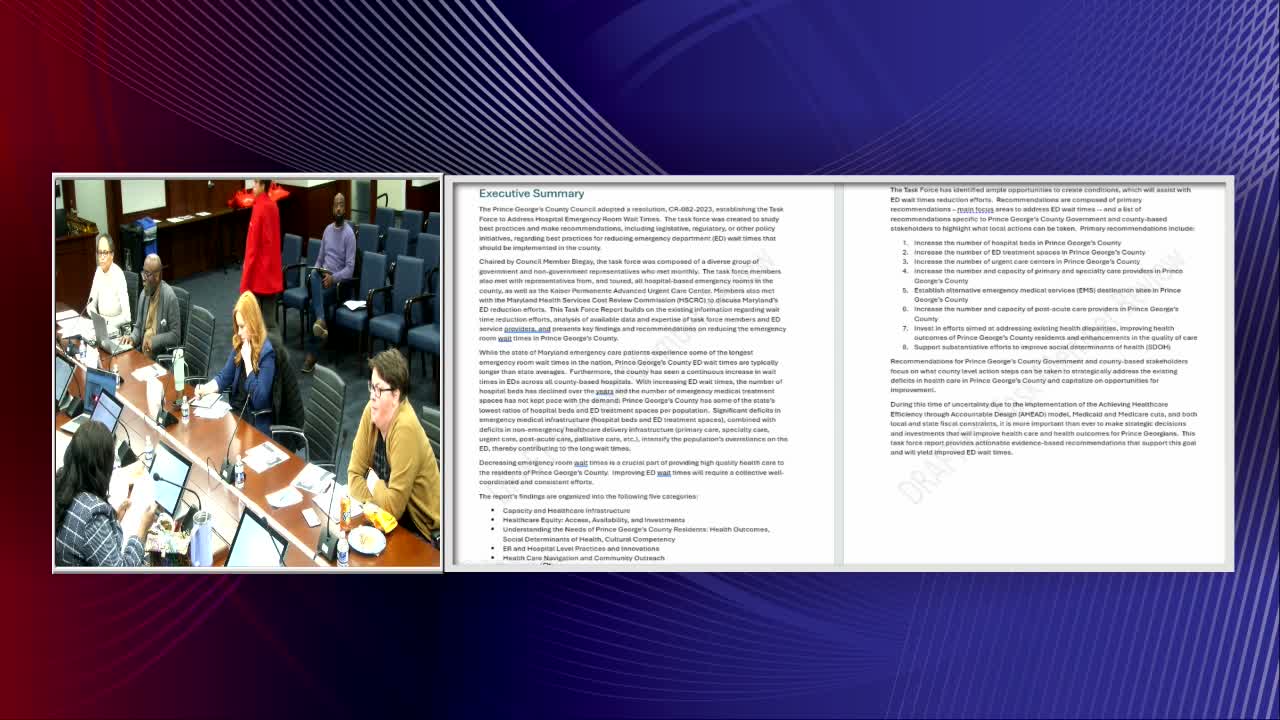
Summary
A county task force finalized a draft report recommending eight primary measures — from expanding primary care to creating alternative EMS destinations — to reduce emergency room wait times and set a Feb. 10 press conference to release the findings; members underscored staffing and hospital cooperation as central challenges.
The Prince George's County Emergency Room Wait Time Task Force finalized a draft report at a culminating meeting, approving a short timeline for partner review and scheduling a press conference for the morning of Feb. 10 to release the findings.
Anya, the task force presenter, told members the new draft adds an executive summary and lays out eight primary recommendations aimed at addressing county emergency department capacity and access. "So the main changes that we have really done to the report is that that you have not seen is that now we do have an executive summary," Anya said, and she asked that the meeting serve as the final opportunity for edits.
The eight headline recommendations are: increase the number and capacity of primary and specialty care providers; increase the number of hospital beds; add emergency department treatment spaces; expand urgent care centers; establish alternative emergency medical services destination sites; grow post-acute care capacity; invest in measures to reduce health disparities and improve care quality; and support efforts to address social determinants of health. Anya said more detailed descriptions and evidence appear in the full report.
The task force emphasized that many of the recommendations require collaboration with county hospitals and outside partners. "Actually executing this level of work would really require complete cooperation and buy in from our hospital partners," Anya said, noting the county can inventory programs and review policies but cannot unilaterally implement many hospital-level changes.
Members pressed several implementation questions. Mr. Eubanks suggested the workforce inventory should include environmental services staff because room turnover affects bed availability, and recommended reviewing New Jersey's staffing-committee model as a potential precedent. Anya said some of that feedback appears in the report's findings and recommended a deeper workforce analysis through existing education and workforce committees rather than forming a new task force.
Several members raised equity and behavioral-health concerns. One member asked whether the recommendation to institutionalize community co-governance (a permanent community health equity council with veto power) would precede staffing research; Anya said the language originated with a task force member and that the recommendation reflects ongoing discussions between council leadership and the county executive but implementation commitments are not yet determined. Miss Turner noted behavioral health was not a focus of the recommendations and Anya acknowledged behavioral health is referenced mainly in findings, estimating (from a state data query) that behavioral-health-related ED calls average about 3% of volume and inviting members to supply additional data.
Next procedural steps were outlined: Anya will make final edits, circulate the draft to hospital partners, the county DCAO and HSCRC for short-period feedback, and then proceed with the planned public release. Members agreed to invite HSCRC and the governor's office to the press conference. The task force adopted the minutes for this meeting before adjourning.
The task force plans additional follow-up work on staffing and workforce pipeline issues after the report is released; several members said long-term progress will depend on hospital cooperation, targeted workforce strategies and clearer data on position-specific hiring and retention challenges.
The task force will release the final draft publicly at a press conference on Feb. 10 with county leadership and invited partners in attendance.