Work group recommends baseline county funding and tighter administration for Prince George's County health-insurance program
Loading...
Summary
The Prince George's County work group recommended a baseline general-fund allocation (draft: $5.5 million, including $5 million for services) and asked FQHCs for site-level 2025 data to finalize an allocation methodology and administrative budget.
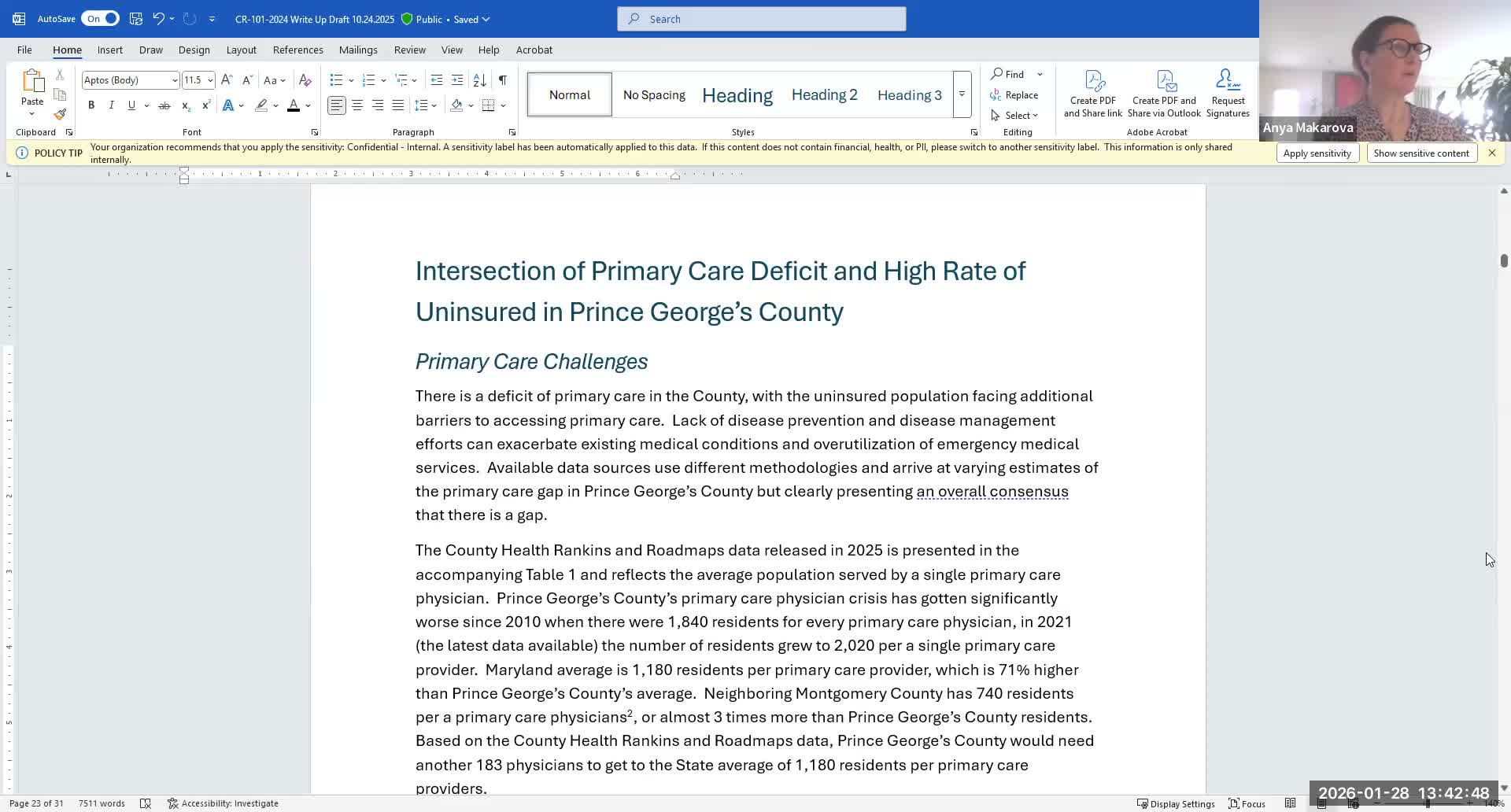
Anya Makarva, senior adviser to the Prince George's County Council and lead drafter of the work-group report, told the group the draft recommends a general-fund allocation of at least $5.5 million for the county’s health-insurance program, with $5,000,000 proposed for direct services and the remainder for program administration.
The recommendation aims to stabilize a program that officials say has been underfunded and inconsistently administered as responsibility moved from a nonprofit to the county health department. Makarva said the county’s nonelderly uninsured rate is 14 percent — roughly 107,200 people — well above the Maryland average of about 8 percent and representing about 27 percent of the state’s uninsured population. “We have 14 percent…roughly estimated at 107,200 people,” she said.
Work-group members said the primary goals are financial sustainability for federally qualified health centers (FQHCs) that serve high numbers of uninsured residents and more transparent reporting. The draft instructs that program funding should include a dedicated administrative allotment; participants noted the program transferred to the health department without additional staff or funds to run it. “There is no systematic programmatic reporting that we receive on [the program’s] performance,” Makarva said, and the group recommended that future budgets include funds specifically for administration and data collection.
The draft also proposes changing the allocation method: instead of reimbursing individual visits on a first-come, first-served basis, the county would base allocations on qualifying visit counts from a prior year and distribute funds among participating FQHCs accordingly. Makarva said the proposal is intended to improve transparency and predictability but acknowledged it would not fully cover all care costs. “The $5,000,000 ask that is currently included in the draft…is not the amount of money that it would take to meet the needs of all uninsured Prince George’s County residents who meet the criteria for the health-insurance program,” she said.
FQHC representatives and county staff discussed data sources to support the allocation change. Providers noted they submit site- and zip code–level patient and encounter data annually to the federal Uniform Data System (UDS), which is validated through a federal clearing process and published in the spring. The group set a deadline for FQHCs to provide calendar-year 2025, site-level data the week of Feb. 16 so staff can plug those numbers into the draft report.
Procedural note: early in the meeting Dr. Sonia Bridal moved to approve the minutes and Diane Young seconded; the transcript records the motion and second but does not include a roll-call tally.
Next steps: staff will request certified site-level data from FQHCs, the health department will work with the group to estimate administration staffing and costs, and the work group will refine the funding recommendation for consideration in the FY27 budget process.