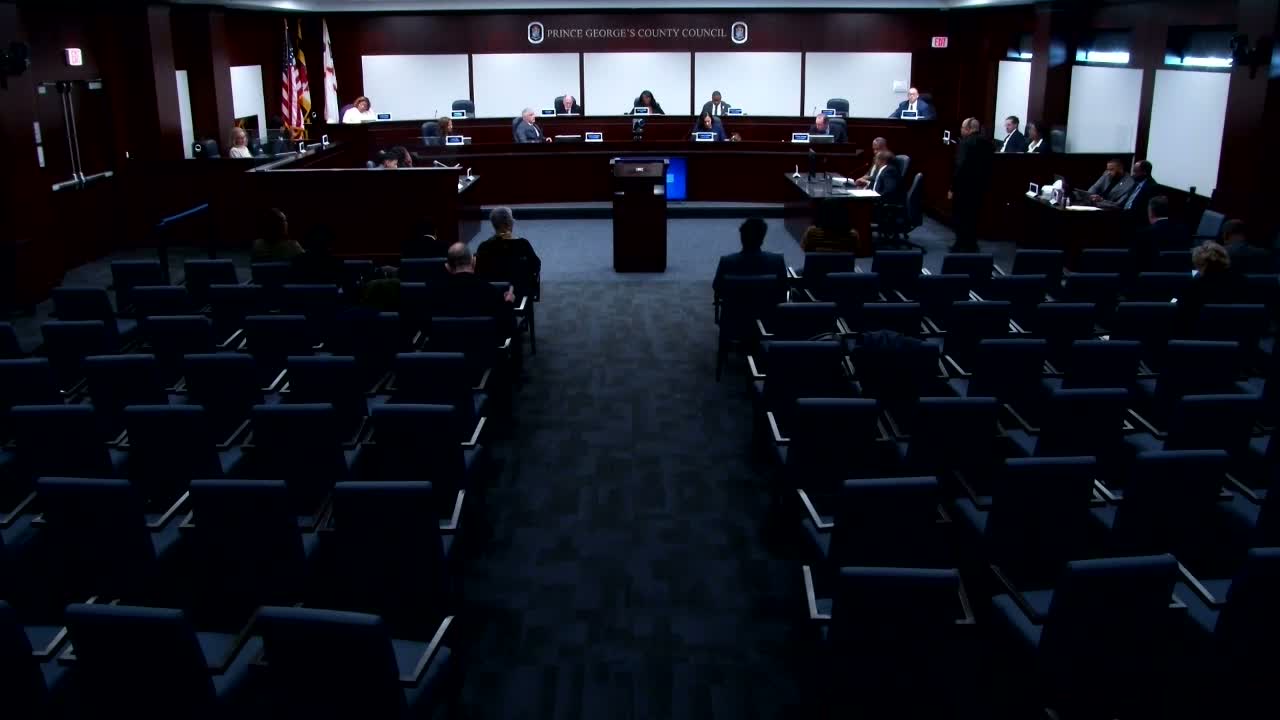
County council flags infrastructure, tree-conservation and local-control concerns with state housing bills
Loading...
Summary
Prince George's County officials briefed the council on the governor's housing package (including Senate Bill 36), and multiple members raised concerns about state preemption of local zoning, lack of funding for infrastructure, and potential conflicts with the county's tree-conservation rules and adequate public facilities policies.
Prince George's County lawmakers used a Feb. 3 briefing to scrutinize the governor's housing package, singling out Senate Bill 36 for the potential to preempt local single-family zoning controls and to shift growth decisions to the state level without guaranteed funding for infrastructure.
Jabari Cooper, who presented the General Assembly committee update to the council, summarized the county's recent committee actions and introduced a more detailed briefing on housing. Cooper and representatives from the state's housing working group (Mako) told the council that SB36 (described in the briefing as a "starter and silver homes" act) would limit county authority over lot size, setbacks and lot coverage and would allow subdivision of single-family lots into up to three parcels, while the bill contains no explicit guarantee that units built under the state authority would be "affordable." Cooper said that the bill would remove longstanding local tools used to manage growth and preserve neighborhood character.
Dom (identified in the briefing as a Mako representative) described the Building Affordably in My Backyard (BAMBI or Bambi) initiative and its four policy buckets: land use, market tools, renter protections and state actions. Lorenzo Bellamy (representing Bellamy Gen Group) added that SB36's language (cited by page and line in the briefing) specifically restricts the legislative body's authority and includes no explicit public-hearing or public-input requirement in the draft.
Council members raised multiple specific concerns in the Q&A: whether SB36 would undercut the county's recent tree-conservation ordinance; whether adequate public facilities (APF) tests and mitigation would meaningfully limit projects; how impact fees (referred to as development excise taxes) would be applied or deferred; and whether municipalities would retain effective zoning control. Council members asked staff for district-level maps identifying properties that could be upzoned under the bill; staff committed to supplying that information and said the county would pursue possible amendments and coordinate with municipalities and neighboring counties.
Several council members emphasized that Prince George's County already has a relatively affordable housing stock compared with neighboring jurisdictions and warned the body not to encourage unmanaged sprawl. Staff and outside presenters said they would continue stakeholder engagement and prepare memos and potential amendment language for the council.
No vote on state legislation occurred at the meeting; staff will continue to monitor bills and propose amendments or positions as the General Assembly session proceeds.