Get Full Government Meeting Transcripts, Videos, & Alerts Forever!
Get email alerts on the Transportation topic
No spam. Unsubscribe anytime.
Traffic expert: Melwood Road can accommodate proposed residential rezoning, study says
Summary
Traffic engineer Michael Lenhart told the Prince George's County hearing that a traffic impact analysis he prepared shows no failing intersections attributable solely to the proposed rezoning, that the site’s access to Route 4 can absorb projected trips, and that standard county review at preliminary plan will address any required mitigation.
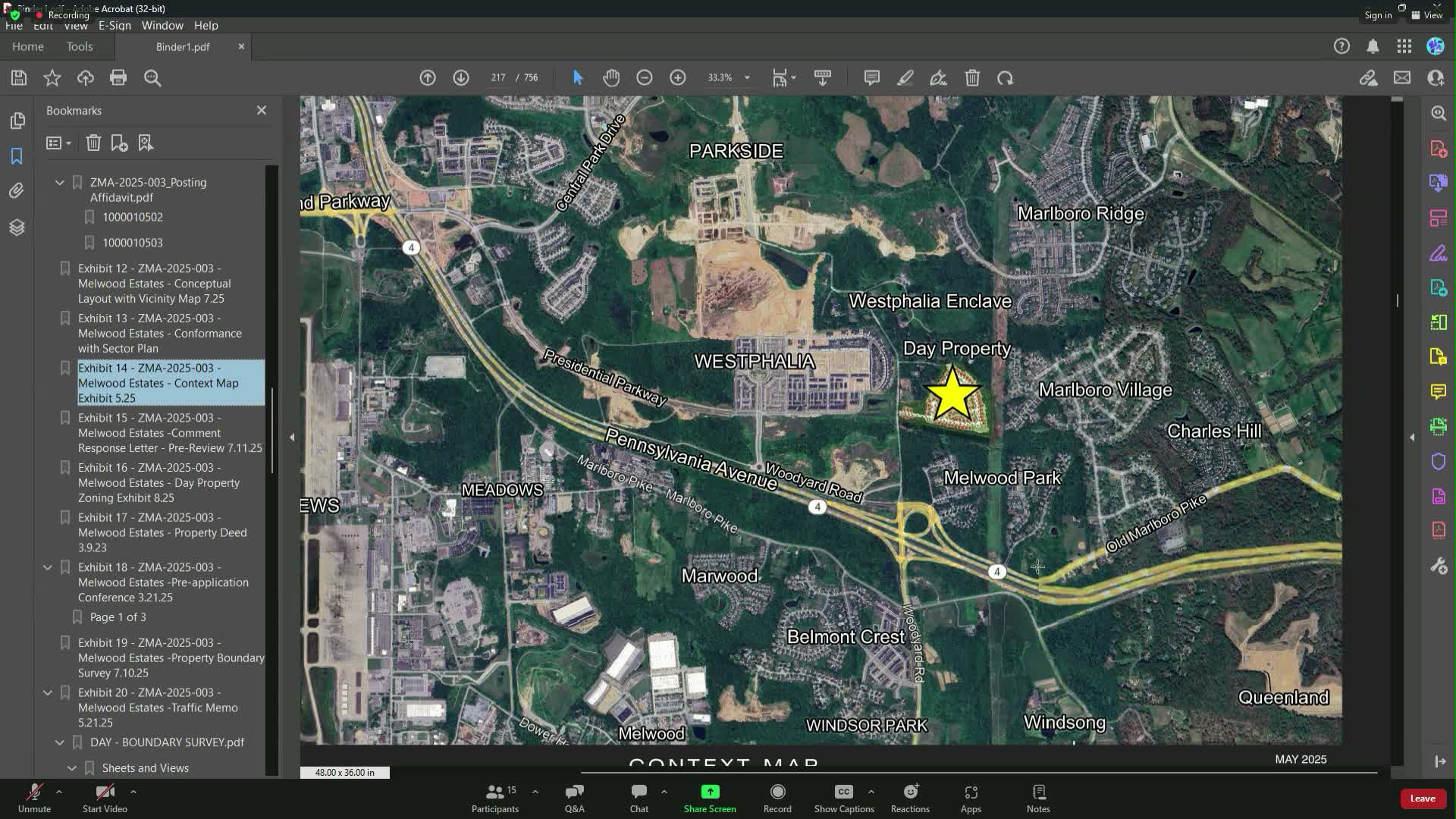
Michael Lenhart, a traffic engineer with Lenhart Traffic Consulting, told the Prince George’s County hearing the Melwood Road site can be served by the existing roadway network and recommended approval of the rezoning from a transportation standpoint. "Traffic on Melwood Road is very light," Lenhart said, and the nearby interchange at Route 4 and Woodyard Road has capacity to handle the development’s traffic.
Lenhart described the materials and methods used for his analyses, including the county’s transportation review guidelines and the Institute of Transportation Engineers trip‑generation manual. He said his team collected existing volumes and reviewed roadway classifications before modeling projected traffic. "We studied 87 dwelling units," he said, noting the applicant’s statement of justification requests up to 96 units; he told the panel the difference between 87 and 96 units is negligible for the study’s results.
Using the county’s required TRG rates (which Lenhart said are older than ITE rates), the study found the proposed rezoning would generate about 783 trips per day compared with roughly 112 trips per day under the existing zoning assumption (about 12 dwellings). Lenhart emphasized that daily trip totals do not equal peak‑hour impacts and said peak hour and off‑peak hour trips from the proposed development were not substantial.
On operational effects, Lenhart testified that all studied intersections passed the county’s adequacy standards and that the analysis did not identify any failing intersections attributable solely to the proposed development. "No impacts were identified that could not be mitigated," he said, and added that any required traffic impact study would also be performed and retested at the time of preliminary plan when adequate public facilities are applied.
Lenhart addressed the choice of trip rates, telling the examiner that the county’s transportation review guidelines take precedence locally and produce a conservative estimate; he noted that ITE rates generally show lower trip generation but that his team followed the TRG to meet county requirements.
Finally, Lenhart recommended approval from a transportation perspective, citing the property’s integration into the existing roadway network, proximity to the arterial and freeway system, and lack of impacts on intervening residential properties between the site and the interchange. He also noted the transportation staff memo did not identify traffic as the basis for recommending disapproval of the application.
Next procedural steps noted during the hearing: traffic will be reassessed at preliminary plan and any mitigations would be handled through the standard county permitting and design review process.