Get Full Government Meeting Transcripts, Videos, & Alerts Forever!
Get email alerts on the Capital Improvement Program topic
No spam. Unsubscribe anytime.
City of Fairfax presents $636.7 million draft five‑year CIP, flags property‑yard cost jump and school bond impacts
Summary
City staff presented a draft FY2027–FY2031 Capital Improvement Program totaling about $636.7 million, driven largely by school bond projects and a sharply revised property‑yard estimate. Staff moved maintenance and software maintenance out of the CIP and urged the commission to prioritize projects ahead of council review.
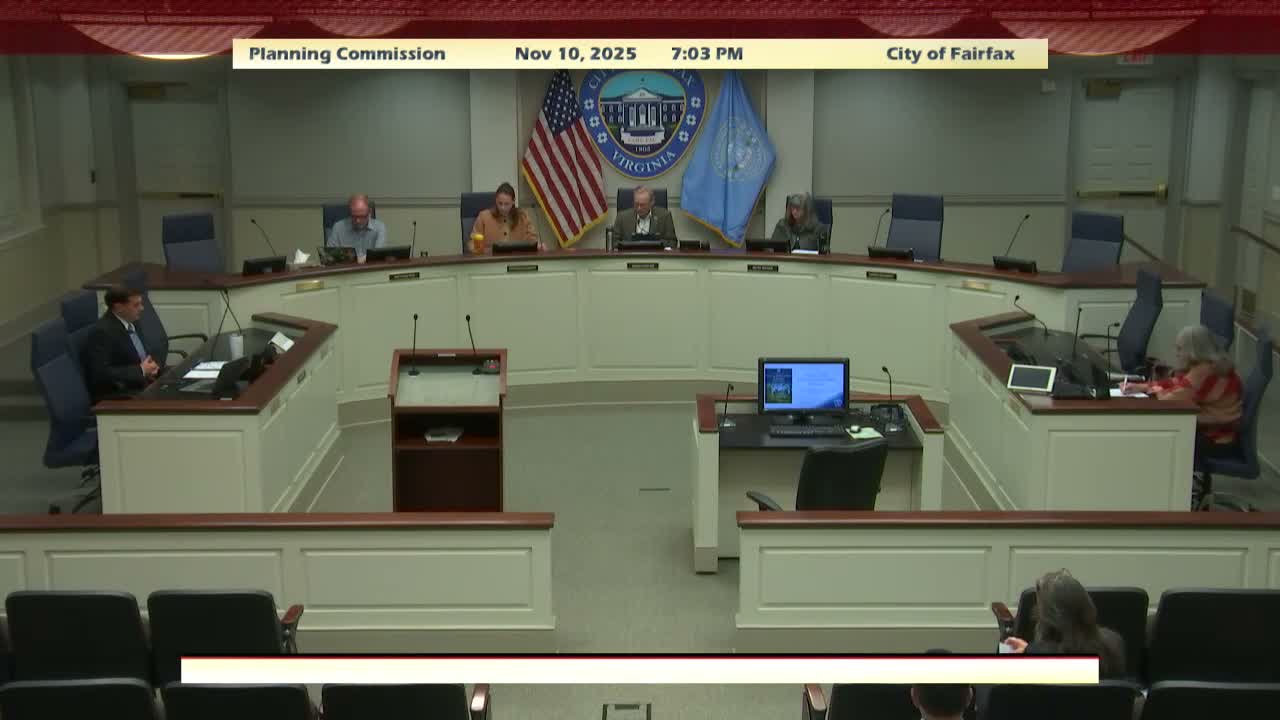
Acting City Manager Melanie Zip and the city’s finance team presented the draft FY2027–FY2031 Capital Improvement Program (CIP) to the City of Fairfax Planning Commission on Nov. 10, outlining a five‑year request staff said totals $636.7 million and noting major drivers that will shape commission recommendations to council.
Zip told the commission the CIP has been tightened to include only true capital projects and that maintenance and most software maintenance were moved back to the general fund. “The project has a useful life of 5 years or more” and “the project costs exceed $50,000,” Zip said as criteria for CIP inclusion. She said ARPA funds remain listed for projects still using those dollars and that staff is working to meet the ARPA spending deadline of Dec. 31, 2027.
The finance presentation said nearly $449 million of the five‑year request is expected to come from the general fund; staff attributed the overall increase from the prior adopted plan mainly to two school bond–related projects: elementary school renovations and a new high‑school roof. The number of funded projects drops from 136 in the FY26 plan to 63 in the FY27 proposal because staff concentrated on higher‑priority and true capital items.
Staff flagged several large, individual items. The property yard — long known to flood and damage equipment — now has a refined, higher estimate: staff said prior rough figures around $65 million have been revised to about $155 million after detailed study. Staff described two high‑cost scenarios: pulling the yard out of the floodplain (which could require acquiring adjacent land and building flood walls) or splitting the yard across two sites (with duplicated fueling and support facilities). No FY27 funding for the property yard was proposed; design and feasibility work were pushed to FY28.
Public safety projects were highlighted as well. Half the funding for the Fire Station 33 replacement is already appropriated, with the remainder expected over the next three years; the city recently acquired adjacent property previously owned by the George Mason University Foundation and will tour Station 33 and Station 3 in coordination with council. Transit scheduling was also discussed: the city plans to replace six ‘‘Q’’ buses in FY27 but cannot preorder under DRPT rules and expects an approximate 18‑month delivery lag, meaning ordered buses might not be received until early FY29.
CFO remarks and subsequent discussion also noted a potential statewide mechanism that could change local school CIP funding: staff said a proposed additional 1% sales tax dedicated to school capital — if passed by the General Assembly and approved locally via bond referendum — could largely offset the school CIP row, but the measure’s passage and local adoption remain uncertain and would phase in beginning FY28 if it proceeds.
Planning Commissioners asked staff for clearer narrative material to explain large line‑item changes (for example, the property‑yard increase) and for an account of options that could mitigate major costs, including potential land trades, parcels the county might transfer back to the city, and coordination with the school board on Green Acres and other parcels. Staff told commissioners the draft CIP would be posted online (scheduled at 09:00 that night) and asked them to review the book before the Nov. 24 meeting so commissioners can identify highlights to discuss ahead of a Jan. 26 recommendation and a joint council session on Feb. 3.
What happens next: staff will publish the draft CIP on the city website, the Planning Commission will discuss priorities at its Nov. 24 meeting, and the commission is expected to vote on recommendations Jan. 26 before a Feb. 3 joint presentation with City Council.