Committee hears details on plan to expand Prop C childcare subsidies to 200% AMI
Loading...
Summary
Department of Early Childhood presented scenarios to use Prop C fund balance and annual revenue to extend childcare subsidies up to 200% of area median income, expand infant/toddler capacity and fund workforce wage supports; the Controller warned of revenue softness and long‑term deficits under some models.
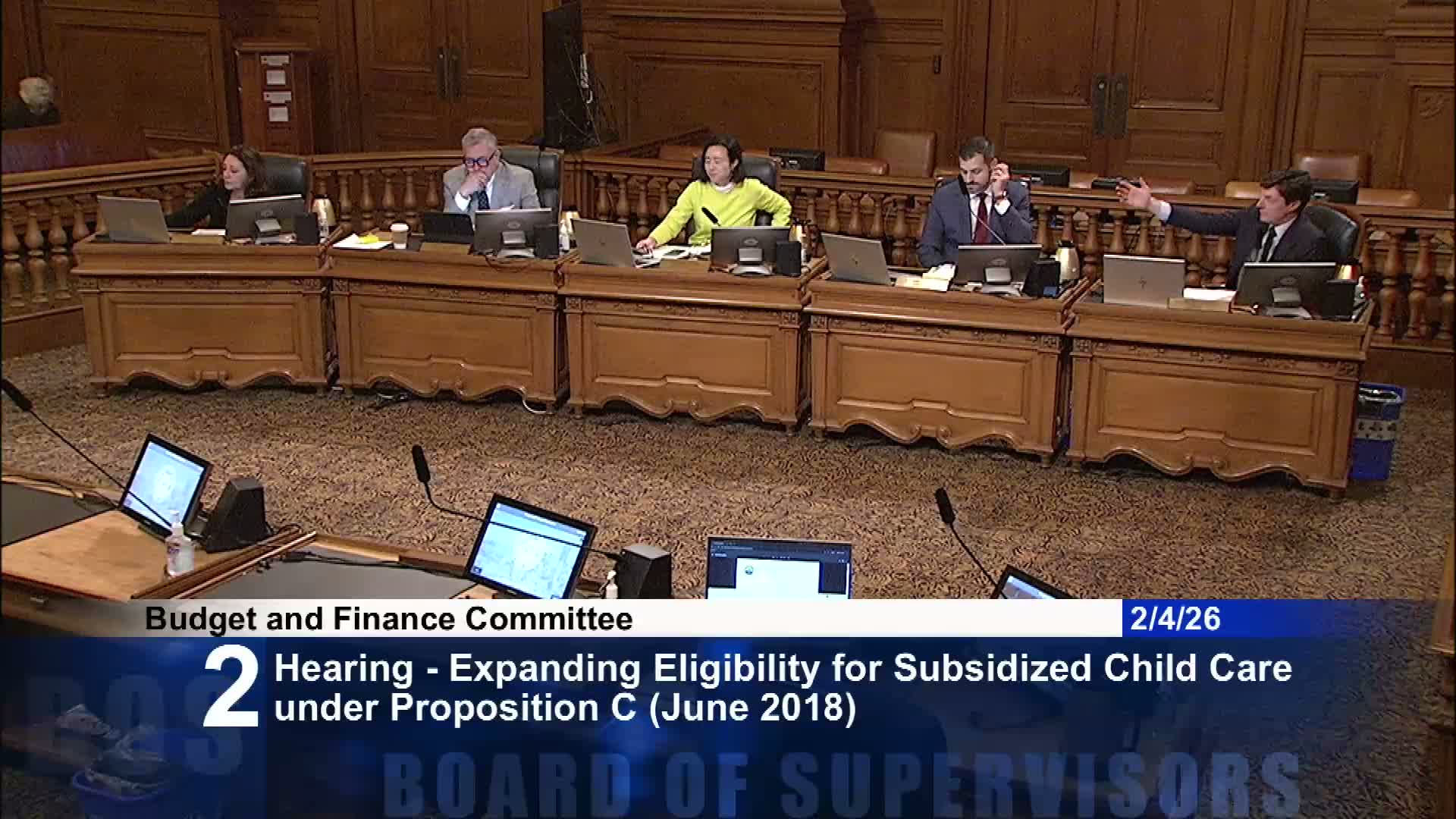
The Budget and Finance Committee held an extended hearing on February 4 about proposals to use the Prop C fund balance and ongoing revenue to expand San Francisco’s childcare subsidy program to families earning up to 200% of area median income.
Director Ingrid Mezquita of the Department of Early Childhood outlined a two‑pronged plan: use one‑time fund balance dollars for capital projects and workforce development while phasing an expanded ongoing subsidy that would increase eligibility to households up to 200% AMI. Mezquita said the plan pairs expanded affordability with investments in infant and toddler facilities and wage supports for early educators, noting these are “coupled” efforts that must be planned together.
Devin McAuley of the Controller’s Office told the committee the commercial rent tax that funds Prop C produced unusually high revenues in 2021 (about $490 million) but has averaged roughly $190 million in recent years and is projected to soften through fiscal 2030. McAuley said the controller’s five‑year revenue outlook constrains how long one‑time balances can subsidize ongoing costs.
Supervisors asked for maps of existing 'alpha' and non‑alpha sites, details on expected uptake, and scenarios that would protect longtime low‑income families if state or federal funding changes. Mezquita said the department plans a phased expansion beginning with fall enrollment cycles and estimates adding roughly 400–600 infant/toddler spaces per year as new providers and classrooms come online.
In public comment, parents and provider groups including Parent Voices, Family Services Alliance and Children’s Council urged pairing the eligibility expansion with immediate supply increases and support for family, friend and neighbor care; they warned that expanding eligibility without adding supply could leave families eligible on paper but unable to find spots.
Chair Supervisor Connie Chan asked the department to present two budget scenarios for the coming June budget process—one assuming no additional federal support and another reflecting higher ongoing revenues—so the Board can evaluate sustainability and reserves before committing to ongoing expansions.