Get Full Government Meeting Transcripts, Videos, & Alerts Forever!
Get email alerts on the Budget Fy26 topic
No spam. Unsubscribe anytime.
Fairfax budget fight centers on school tuition spike, potential tax increases and arts funding
Summary
At a March 25 public hearing and work session, residents urged the city to preserve arts funding while the school board chair described a $12.6 million tuition increase to Fairfax County Public Schools; council discussed meal‑tax increases, a proposed real‑estate tax rate adjustment, a 10% reduction exercise and one‑time cash options.
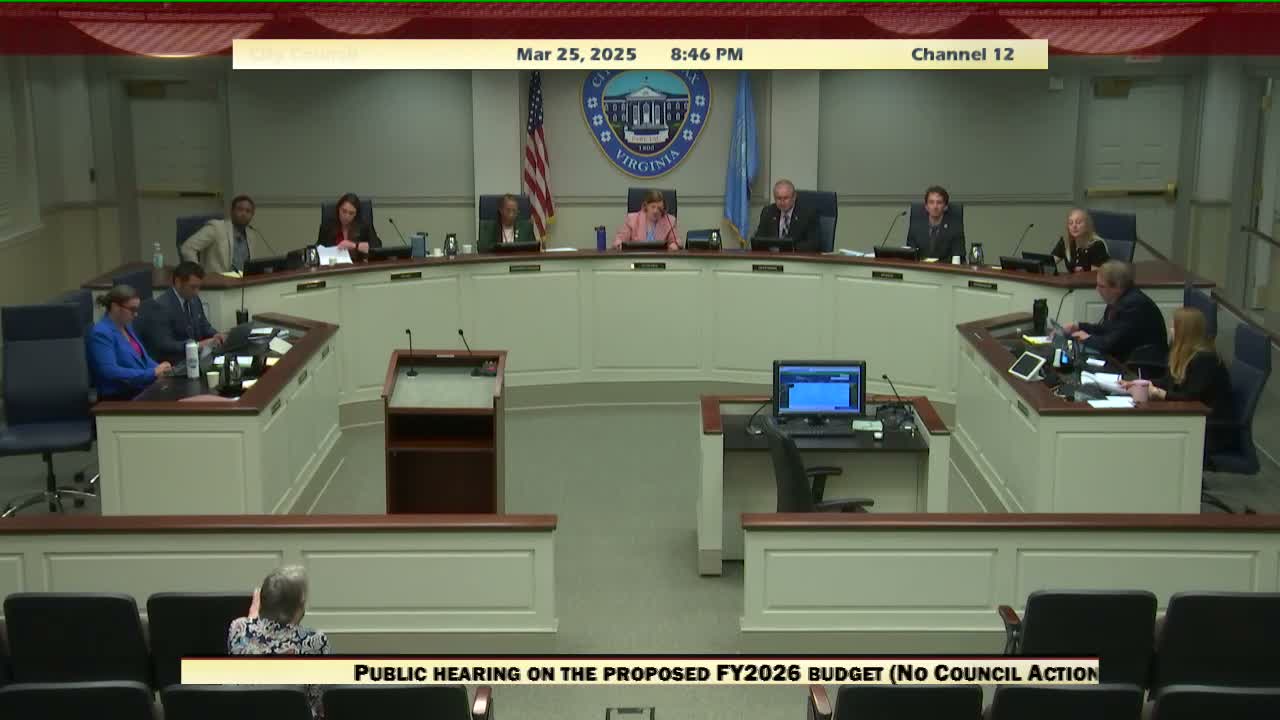
Fairfax City’s March 25 meeting included an extended public hearing and a budget work session focused on a proposed FY2026 plan that would rely on a mix of revenue and expense changes to close a funding gap.
During the public hearing, arts and community groups asked the council not to cut support for Fall for the Book, the City of Fairfax Theater Company and the City band. Tamara Harvey, chair of Mason’s English department and a longtime resident, appealed to council to keep the city’s $25,000 annual contribution to Fall for the Book, arguing the festival generates economic activity for local businesses. Leaders of the City of Fairfax Theater Company and the City band described cultural and economic benefits and urged continued support.
School Board Chair Carolyn Pitches presented the school system’s budget context. She said roughly 90 percent of the city’s school operating budget is tuition paid to Fairfax County Public Schools and that the city faces an atypical $12,600,000 increase in the tuition bill — driven by rising county costs and enrollment increases (she said average daily membership rose by 161 students over two years). Pitches warned that terminating the FCPS contract would require action by both the council and the school board, take effect only after a three‑year transition, and require building a full school division — a costly and complex multiyear process.
Council heard a range of resident concerns about affordability. Multiple speakers said proposed tax increases would be difficult for retirees and fixed‑income households. Paul Hopkins and others described how recent assessment increases and proposed real property tax adjustments materially raise household bills.
In the work session, City Manager Brian Foster and CFO JC Martinez reviewed revenue options and the council’s requested 10% reduction exercise. Staff outlined several levers: a real estate tax rate increase (council discussed a scenario that included about a 9.5¢ increase on the tax rate), an increase to the meals tax, a split billing option for personal property tax to create one‑time revenue in the transition year, and using one‑time cash resources tied to a 2020 debt issue (about $6.8 million) to cover near‑term obligations. Foster warned that many budget items are nondiscretionary — school tuition, shared services and debt service make up a substantial portion of the general fund — which limits how much can be saved without cutting services or staff.
Council debate was robust and divided. Some members said they would not support the full proposed 9.5¢ real estate tax increase or a meals‑tax hike; others urged exploring a mix of smaller revenue increases and targeted reductions, and increasing public outreach via the April 2 open house at the Stacy Sherwood Community Center. Council members also asked staff for clearer contract and consultant scopes to identify where staff could substitute for outside contracts.
Staff emphasized next steps: the public hearing stays open until April 8, the council will hold a budget‑focused work session April 1 (all work session day), and an April 2 open house is planned. Staff also noted the potential long‑term option of pursuing a regional 1¢ sales tax, which would require state action and a voter referendum and could materially change funding assumptions for school and capital projects.
Provenance: This article draws on the March 25 FY2026 public hearing testimony and the subsequent budget work session discussions (public speakers and staff presentations).