Get Full Government Meeting Transcripts, Videos, & Alerts Forever!
Get email alerts on the George Snyder Trail topic
No spam. Unsubscribe anytime.
Fairfax debate narrows on George Snyder Trail as council weighs partial build or cancellation
Summary
After hours of public testimony and staff presentations about environmental impacts and funding, Fairfax City Council asked staff for more detail on a west-half construction option and potential repayment risks if the full George Snyder Trail is canceled; the council did not take a final vote on the trail.
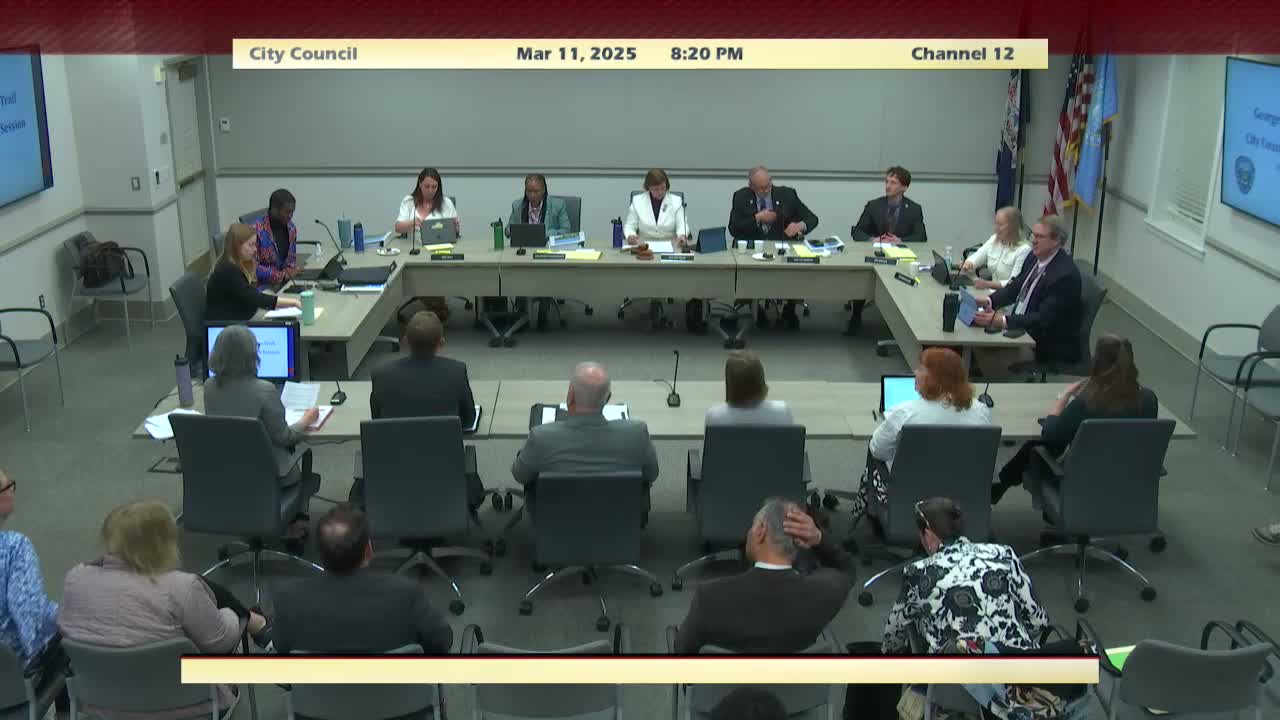
The Fairfax City Council spent the evening examining the contentious George Snyder Trail project and asked staff to return with detailed options for constructing only a western segment, canceling the project or proceeding with the full alignment.
Mayor Catherine S. Reed told the council the trail was part of a regional commitment tied to concessionaire funding, and that the city had obligations to its Northern Virginia partners: "When funding is given to a jurisdiction it is because we made a commitment to build a project that benefits our city but also benefits this region," she said. Reed said the city had received federal and state approvals and right-of-way has been acquired, which limits the options available to reverse course quickly.
Staff presentations summarized the technical and environmental trade-offs. Transportation Director Winnie Sanford told council the project is at 100% plans, with federal authorization to advertise valid through May, and reported about $3,700,000 already spent on design, environmental review and right-of-way. Urban forester Anna Stafford said the trail alignment's estimated limit of disturbance for the full project is about 6.18 acres (3.81 acres inside the Resource Protection Area) within roughly 72 acres of canopy and that approximately 568 trees (measured as 5 inches diameter or larger under the city standard) were identified for potential removal under the current design. Stafford said mitigation measures include replanting in the RPA and invasive-species management.
Opposition at the mic and on the dais centered on tree loss, wetlands and process. Residents said they repeatedly asked for alternatives and described a lack of early public engagement. "There has been substantial public opposition to this project," said Judy Fraser, a resident and former GSTAG member, during public comment. Supporters, including residents representing Fairfax City Citizens for Smarter Growth, argued the greenway would provide missing connectivity for walkers and cyclists and link to regional trails.
Staff outlined three formal options for council: - Proceed as proposed: the $20 million project would move to construction when the city awards the contract; no additional council action is required. - Cancel the project: council action would be required; VDOT and the Commonwealth Transportation Board (CTB) could require repayment of concessionaire funding or other costs depending on timing and the CTB's determination. - Build the west half only: VDOT has suggested a truncated option that could preserve most of the city's ability to keep concessionaire funding and avoid repaying some costs; staff estimated the west-half cost at about $12 million and said VDOT told them it would likely not require repayment of the $3.7 million already spent, though unused right-of-way funds could have 20-year repayment conditions.
Council members asked for more detail before committing. Several members said they would not support a full eastern build as currently proposed and favored either the truncated west-half plan or further discussion with VDOT and the CTB. Council asked staff for: (1) a clearer cost and schedule breakdown for the western-only option including the city-paid redesign estimate (staff suggested roughly $20,000—5,000 to re-scope); (2) the public-engagement record and correspondence from past years (GSTAG notes, public hearing comments); and (3) a high-level conferral with the CTB representative for Northern Virginia to understand repayment risk and approval likelihood.
Staff emphasized constraints: many alignment decisions were reached in prior design phases, acquisition and federal permitting limit flexibility, and VDOT staff told the city they do not generally recommend waivers of repayment once projects reach 100% plans and right-of-way acquisition. Sanford said the authorization to advertise is time-limited and that postponing the project will require additional design review and likely city expense.
The council did not vote on the trail at this meeting. Instead, members directed staff to return with the requested analyses and to set out the timeline and costs needed for a western-half redesign so council can decide before the May window for advertisement closes.
What's next: staff will provide a written package with the GST public-engagement history, a western-half cost/schedule estimate, and recommended next steps for CTB engagement. Council members signaled they expect that information before deciding whether to advertise for bids under the full plan, pursue the west-half option or formally cancel the project.