
Environmental Sustainability Committee urges staff hires, fast‑tracked climate plan and green building adoption
Get AI-powered insights, summaries, and transcripts
Subscribe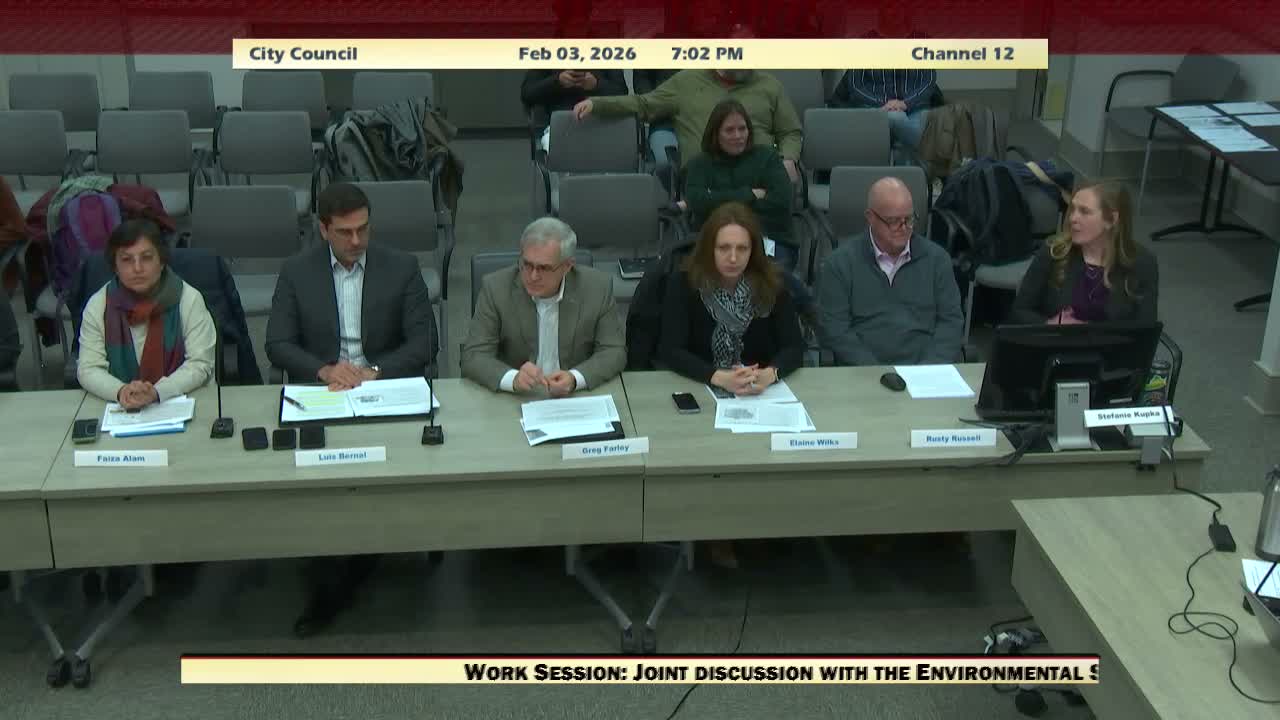
Summary
The Fairfax City Environmental Sustainability Committee told council it needs a full‑time Climate and Energy Manager, faster Climate Action Plan timelines and adoption/implementation of the green building policy to connect projects to measurable ROI and meet city targets.
The Environmental Sustainability Committee (ESC) presented a state‑of‑sustainability overview to the Fairfax City Council on Feb. 3, 2026, urging the council to prioritize staffing and measurement so projects can be tracked and scaled. ESC chair Rusty Russell and committee members described a roadmap of actions for the next 12 months and recommended a shorter priority list for council support.
Committee members and staff highlighted several near‑term priorities. Greg Farley urged hiring a full‑time Climate and Energy Manager, development of a climate and energy action plan, and adoption of a green building policy. Pradeep Jilka said the Climate Action Plan has been repeatedly deferred (he said it was first funded in 2024 and has again been delayed, with the earliest start he was told being 2028) and recommended reprioritizing the plan and deploying utility data management software so the city can ‘‘track traction’’ not just actions. Jilka added that a completed LED streetlight conversion could save about $150,000 annually.
Staff noted constrained capacity in the Environmental and Sustainability Division — currently two staff (Stephanie Kupka, Sustainability Program Manager, and Melissa McDonald, Environmental Sustainability Specialist) — and said that implementation of the green building policy as drafted would require about 25 hours per week of staff time and cost roughly $85,000 annually. The city has secured several grants that support near‑term work: an $80,000 regional grant to help install EV chargers, a $50,000 grant that funded a temporary part‑time climate and energy manager, and an EECBG award supporting residential energy audits and outreach.
Councilmembers pressed staff on sequencing, return‑on‑investment data, and costs for proposed additional staff and systems. Several councilmembers asked that staff produce a simple matrix showing estimated costs, expected savings or revenue, beneficiary counts and priority timing for each proposed action so council can weigh trade‑offs in the upcoming budget process. Staff said some projects paused by a previous city manager for fiscal reasons would be revived as capacity and budget allow.