Cochise County supervisors review proposed anti‑blight ordinance that shifts appeals, expands abatement powers
Loading...
Summary
At a Feb. 5 work session in Bisbee, Cochise County Development Services presented a proposed Anti‑Blight Public Nuisance Abatement ordinance that would consolidate overlapping code rules, move most appeals to an administrative hearing officer, and allow assessment of abatement costs on property taxes under ARS 11‑2‑68.
At a Feb. 5 Cochise County Board of Supervisors work session in Bisbee, Development Services Director Miss McLaughlin presented a proposed Anti‑Blight Public Nuisance Abatement ordinance she said is intended to modernize enforcement tools, clarify rules and strengthen the county’s ability to recover abatement costs.
"This ordinance is intended to build on that strong foundation providing clearer authority and more efficient procedures and better tools to support staff while continuing to emphasize voluntary compliance whenever possible," McLaughlin said during the presentation.
The proposed ordinance would consolidate two existing county measures—identified in the presentation as "Ordinance 41 11" (the 2011 hazard abatement ordinance) and "Ordinance 32 0 3" (the 2003 solid‑waste/dumping ordinance)—into a single nuisance‑abatement framework for unincorporated Cochise County. Key features described by staff include defined blight and public nuisance conditions, structured timelines for notice and compliance, administrative appeal pathways, and explicit cost‑recovery mechanisms when the county must abate a property.
A central procedural change in the draft is routing routine appeals first to an administrative hearing officer under ARS 11‑8‑15 rather than automatically to the board. A county legal advisor summarized the statutory change staff says enables a more streamlined response for hazards that threaten public health or safety: "ARS 11 2 68 gives us that right to do many more things at the administrative level," the advisor said, adding that the toolset would let the county document abatement costs, seek a court warrant to enter a property when necessary, abate hazards, and place certain abatement costs on the property tax roll.
Staff outlined the proposed timeline for enforcement: a notice to abate with at least 30 days to comply, a 15‑day appeal window to the hearing officer, the hearing officer’s decision with judicial review available to superior court, and, if noncompliance persists, county abatement and documented cost recovery. McLaughlin also noted the board would need to approve assessments that exceed $5,000 and that a notice of pending lien would provide 30 days to pay before a lien could be recorded under ARS 11‑2‑68.
Supervisors pressed staff on several protections and operational questions. Multiple supervisors voiced concern that routing appeals to a hearing officer could reduce direct constituent engagement with supervisors, particularly in emotionally fraught cases. One supervisor, citing a long‑running constituent case, asked whether the change would prevent them from intervening before a case escalated; staff responded that supervisors would continue to receive notice information and could intervene or request work sessions while appeal windows were open.
Other concerns included: the potential for the complaint process to be "weaponized" by neighbors, the need to protect elderly or resource‑limited residents who may struggle to comply or afford appeals, and the risk of adopting suburban standards in rural areas. Supervisors repeatedly urged that the ordinance include tiered standards keyed to zoning and proximity to neighbors so rural properties are not regulated like subdivisions. McLaughlin said staff plans to include clearer inspection checklists and zoning‑specific site development standards in parallel text amendments.
Staff and supervisors also discussed practical mitigation options—such as temporary dumpsters, community cleanups and waiver mechanisms—and the limits of some grants, which are often restricted to owner‑occupied properties. McLaughlin said staff would coordinate with the treasurer and finalize implementation procedures, forms and public education materials before a public hearing.
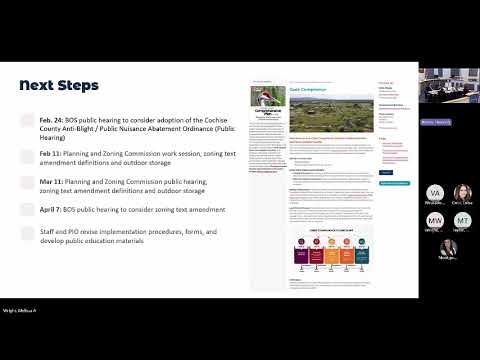
The next formal step is a board public hearing to consider adoption of the ordinance; staff said they will prepare the text amendment for outdoor storage and bring zoning updates to the Planning and Zoning Commission before returning to the board. No formal vote or ordinance adoption occurred at the Feb. 5 work session.
Reporting note: direct quotations and procedural descriptions in this article come from the Feb. 5 Cochise County Board of Supervisors work session transcript and staff presentation.