Cochise County supervisors raise privacy, security concerns over Flock AI license-plate cameras; sheriff to revise grant language
Loading...
Summary
Supervisors warned that cloud-based Flock AI cameras create persistent vehicle/person 'data mosaics,' cited misidentification and security vulnerabilities, and said the sheriff's office will return with modified grant language and alternative vendors that keep data under local control.
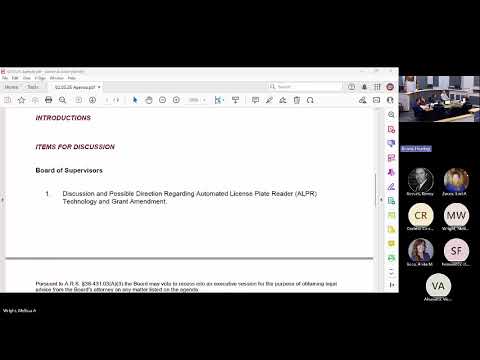
Cochise County supervisors spent Thursday's work session warning that cloud-based, AI-driven license-plate camera systems marketed by Flock AI pose privacy and security risks and said the county's sheriff's office will return with modified grant language and vendor options that would place data control with the sheriff.
The board's chair, who opened the session, said the county is not opposed to traditional, closed-network license-plate readers used for Amber alerts or criminal investigations, but described a different class of systems that, he said, ‘‘are not just looking at the license plate’’ and instead ‘‘build what they call a data mosaic of your vehicle’’ by analyzing color, dents, bumper stickers and occupants. He said the mosaic can persist after video is deleted and be used for both law-enforcement and commercial purposes.
Why it matters: Supervisors said the cloud model creates a long-term surveillance record that can be searched or sold outside local control, raising Fourth Amendment and due-process concerns. The chair referenced the Supreme Court’s Carpenter v. United States decision on long‑term location tracking and described a U.S. district court finding in a Virginia case that, in that instance, municipal use of camera-tracking could implicate similar privacy expectations.
Examples and security concerns: The chair recounted a Colorado incident in which a Ring doorbell clip combined with Flock data produced a mistaken identification, and he described other accounts of false positives and high-dollar lawsuits after incorrect LPR matches. He said independent researchers had reported numerous vulnerabilities in Flock's system and that Flock limits independent verification of security fixes. He also quoted the company’s own public claims—saying Flock has credited camera deployments with roughly a 14% drop in crime and a 22% increase in clearance rates—while noting independent audits have questioned whether some credited gains preceded the company’s involvement.
Policy and procurement: Supervisors discussed key distinctions between leased, cloud-first camera contracts and closed systems sold directly to law‑enforcement partners. The chair said Flock typically leases cameras and imposes standard terms that limit local audit access, whereas some vendors offer closed networks where data access is tightly controlled by the local agency.
Next steps: The chair said the sheriff's office will return in a future work session with modified grant language and a list of alternative vendors that would allow local control of cameras and data and require intergovernmental agreements (IGAs) for outside access. No formal board action or vote was taken at the work session.
What remained unresolved: Supervisors said they want to preserve legitimate law-enforcement utility while preventing creation of an externally searchable, commercialized surveillance database. The board did not adopt new policy at the meeting; the sheriff's office will present revised grant language and vendor options for further review and a possible reapproval vote in a future meeting.