Guam tax-amnesty bill advances to markup after DRT warns of workload and legal clarifications
Loading...
Summary
Sen. Joe S. Saint Augustine's Bill 231-38 would codify a time-limited tax amnesty program. The Department of Revenue and Taxation said it has existing administrative relief tools but that codification would require clear statutory boundaries, safeguards to preserve long-term compliance, and resources to handle increased caseloads; DRT noted 2018 amnesty raised $30.1M that went to the general fund.
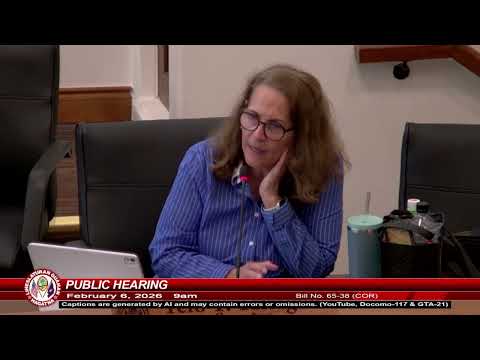
The Committee on Finance and Government Operations heard Bill 231-38 COR on Feb. 6, 2026. Introduced by Sen. Joe S. Saint Augustine, the bill would add a new Article 8 to Chapter 26 and a new subsection to Chapter 24 of Title 11, Guam Code Annotated, authorizing a codified, time-limited Guam tax amnesty program and a parallel real property tax amnesty program.
Sen. San Agustin said the measure responds to Guam's economic challenges and would encourage delinquent taxpayers to resolve liabilities by waiving penalties and interest for eligible participants who pay principal in full or through structured plans. He cited the 2018 program, saying "nearly 900 delinquent taxpayers participated, resulting in $30,100,000 in actual collections out of $35,200,000 pledged by the program close." He argued the bill would provide predictability and allow the Department of Revenue and Taxation (DRT) to set timing and administrative requirements.
DRT acting deputy director Michelle Santos and Tax Enforcement Administrator Carolyn Rivera testified that while DRT already has authority to grant individualized relief (waivers, installment agreements, offers in compromise), mass, time-limited amnesty programs are administratively distinct and impose sizable processing burdens. Rivera recommended codifying legislative intent while leaving operational parameters to DRT, and she recommended clarifying the bill's applicability to income-tax mirror-code entities to avoid federal conflict. "What is not expressly defined in statute, absent legislative action, is a mass time limited island wide tax amnesty program that provides uniform relief from penalties and interest without the individualized conditions typically required in routine compliance determinations," Rivera said.
During questioning, senators pressed DRT on several operational issues. Senator Gumatato cited OPA Report No. 1303 (Aug. 2013), which identified $15.7M in unrealized real-property tax revenue due to valuation and systems issues, and asked whether DRT had pursued moratoria or reappraisals for senior exemptions; DRT said exemptions require application and board approval and that DRT is pursuing modernization but many residents need in-person assistance. When asked whether the Department reinvested the $30.1M collected in 2018 to strengthen collection capacity, Michelle Santos replied, "It goes to the general fund." Several senators pressed the idea of an administrative fee or other mechanism to offset DRT's additional workload during an amnesty.
Committee members and the bill's author agreed to work with DRT on technical clarifications — including explicitly distinguishing penalty and interest relief from tax principal, exclusion criteria (for those already under audit or investigation), eligibility periods, and post-amnesty compliance requirements — and to develop amendment language for the markup. The committee accepted written testimony for seven days and did not take a vote at the hearing.