
Stanford researcher urges CalSTRS to treat AI as a governance—not just technical—challenge
Get AI-powered insights, summaries, and transcripts
Subscribe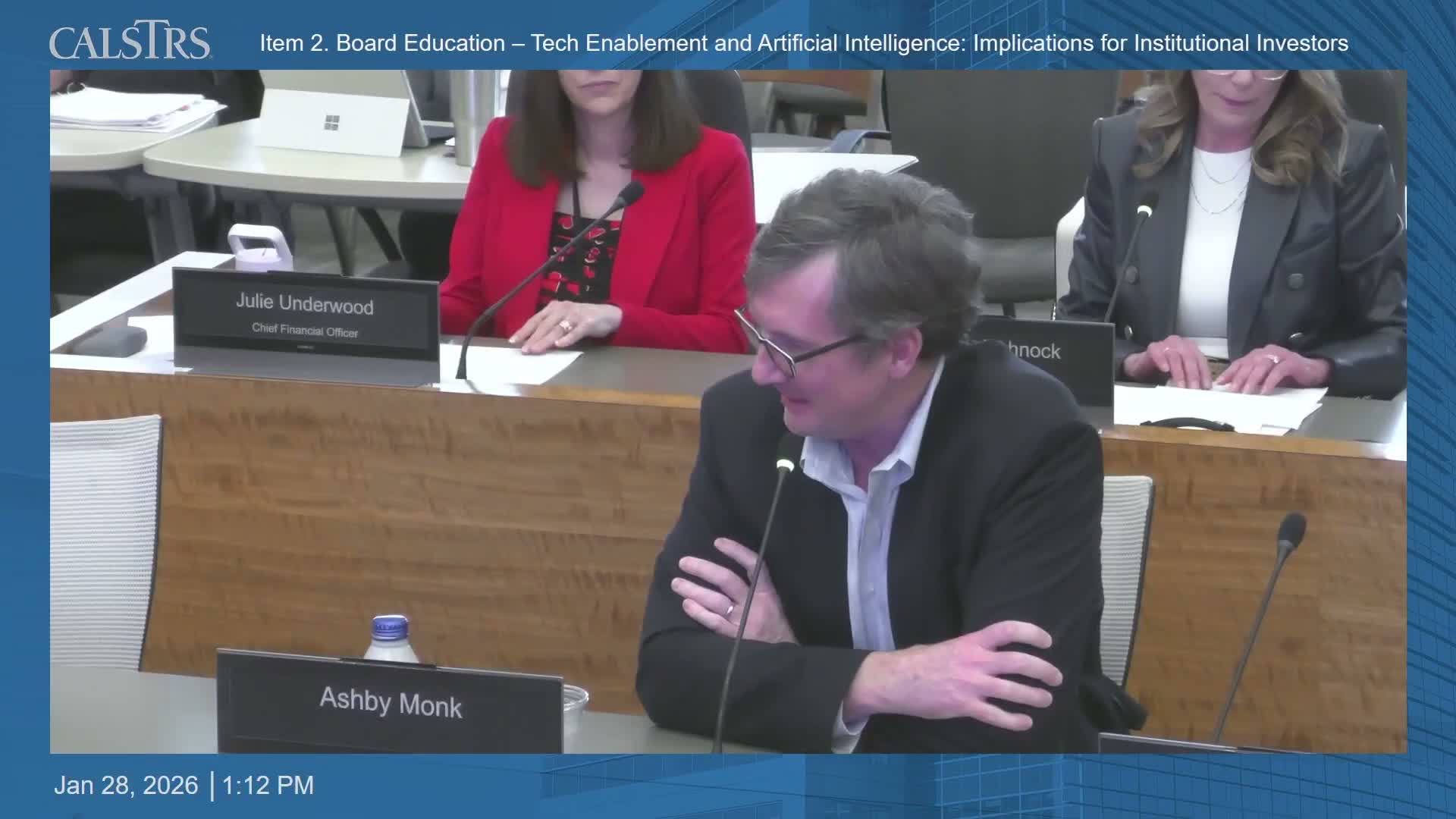
Summary
Dr. Ashby Monk told the CalSTRS board that AI and alternative data are reshaping institutional investing and that boards need a data-first 'portfolio GPS,' sandboxes for testing, and clearer Board-level governance to manage both opportunity and risk.
Dr. Ashby Monk, a researcher at Stanford University, told the California State Teachers' Retirement System board that artificial intelligence and alternative data are shifting the foundations of institutional investing and demand new Board-level governance.
"We're more in the artificial knowledge moment," Monk said, urging trustees to focus first on governing and cleaning data so AI can provide trustworthy decision support rather than replace human judgment. He argued that AI delivers two distinct advantages—speed (data latency) and novel inferential depth—that together change how portfolios are managed.
Monk laid out a practical framework for boards: identify the fund's institutional "identity" (its liabilities, culture and time horizon), build a trusted data layer that serves as a portfolio "GPS," and pilot limited, high-value use cases in safe sandboxes. He recommended methods such as parallel red-team analyses—running AI-driven and human analyses side by side—to surface divergent assumptions without immediately delegating decisions to machines.
Board members pressed on concrete governance steps. Trustee Juarez asked whether the board should establish an investments chief technology officer; staff said investment data solutions are currently overseen by Senior Investment Director April Wilcox, and a team is being formed under her direction.
Monk cautioned that while automation will alter some roles, the current industry still relies heavily on human judgment. "Human judgment is everything today," he said, adding that the sector should be deliberate about when and how to scale AI once pilots demonstrate reliable, auditable outcomes.
Why it matters: CalSTRS manages retirement promises for roughly 1,000,000 educators and has a multidecade investment horizon. Monk said boards that pair a long-term view with trusted, governable data and focused pilots can capture lasting benefits from AI while avoiding unmanaged risk.
What’s next: The board's staff technology governance working group will continue work to define the Board's oversight role and identify resources the board needs to execute meaningful technology oversight. Staff and trustees signaled interest in targeted pilot projects and additional educational sessions.