Get Full Government Meeting Transcripts, Videos, & Alerts Forever!
Get email alerts on the Water Resources topic
No spam. Unsubscribe anytime.
Central Arizona Project officials warn of stalled Upper Basin talks, Feb. 14 deadline
Summary
Central Arizona Project leaders told the Pima County Board of Supervisors that decades-long drought and declining runoff have left Arizona vulnerable, and that stalled negotiations with Upper Basin states risk Bureau of Reclamation intervention after a Feb. 14 deadline.
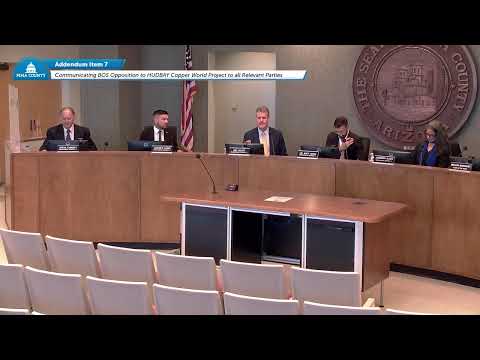
Central Arizona Water Conservation District officials told the Pima County Board of Supervisors on Jan. 20 that Arizona faces mounting water risks as Colorado River runoff declines and interstate negotiations remain stalled. Karen Caesar, CAP board secretary representing Pima County, and Mark Taylor, CAP director and Pima County representative, briefed supervisors on water-source mixes and conservation efforts.
"About a third of our water comes right now from the Colorado River," Caesar said, adding that Tucson is a leader in using reclaimed water. She highlighted that 2025 showed a troubling pattern: roughly 92% of average snowpack produced only about 49% of expected runoff, a trend that reduces river flows and heightens shortage risk.
Taylor described negotiations with Upper Basin states as unproductive after more than two years of talks. He warned the board that the Bureau of Reclamation has set a Feb. 14 deadline for the seven basin states to reach agreement on sharing shortages; absent a deal, the bureau could direct allocations or trigger litigation. "We're down to less than a year now," Taylor said, urging regional attention to the stakes for Central Arizona Project deliveries and Tucson's near-total dependence on CAP water.
Supervisors pressed CAP officials on how conservation and local actions feed into broader negotiations and how CAP tax revenues are set and used. Caesar said about 10% of CAP revenue is funded by property tax assessments and is typically allocated to infrastructure upgrades; the bulk of CAP revenue comes from rates charged to water users. Taylor confirmed agriculture consumes the majority of Colorado River water (CAP cited figures near 70% for agricultural uses) and said working with agricultural users on efficiency and crop choices could be among the faster ways to free water for other needs.
CAP officials urged local leaders and residents to sign up for CAP communications and to join a statewide coalition, Protecting Arizona's Lifeline, that aims to show unified political support for preserving CAP deliveries. The board did not vote on any action following the briefing.
Next steps: CAP leaders said they will continue negotiating with Upper Basin counterparts and encouraged elected officials to monitor the Feb. 14 deliberations. The bureau may make unilateral decisions if the states do not reach an accord.