
Bernalillo County steering committee advances draft community benefits rubric, schedules Feb. 18 working session
Get AI-powered insights, summaries, and transcripts
Subscribe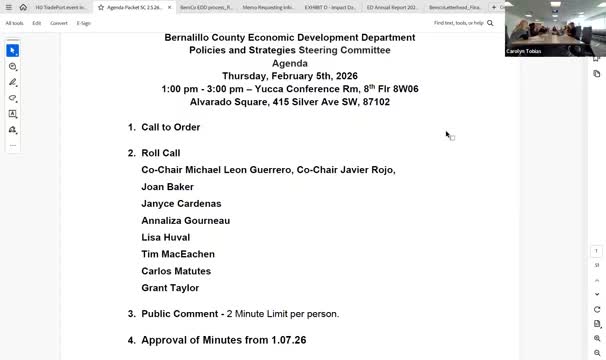
Summary
Steering committee reviewed an updated community benefits rubric the County Commission requested, debated scoring and process concerns and agreed the rubric should be embedded in the incentives application; members set an extended Feb. 18 working session to finalize edits before commission consideration.
BERNALILLO COUNTY — The Bernalillo County economic development steering committee met to review an updated "community benefits" rubric intended to guide how the county evaluates requests for economic incentives. A staff reader told the committee that the County Commission had directed the steering committee to meet one final time to complete the rubric and produce a recommendation for the commission.
"The objective of today's meeting is to review the updated draft, resolve any remaining issues, and align a final recommendation to advance to the commission," an unidentified staff member read into the record. Cochairs Javier D'Rocco and Michael Leon Guerrero opened the meeting and confirmed quorum.
Committee members agreed the rubric's primary function should be to make explicit how proposed projects will meet Bernalillo County's economic development goals — transparency, accountability and inclusiveness — and recommended that the rubric be completed as part of the incentives application so staff and the commission can evaluate scores and any subsidy consequences. "If the goal makes sense, the rubric should make sense," the facilitator summarized.
The meeting included pointed concerns about how the current draft was produced. Several members said a small subgroup had drafted substantive edits without broad input. "In the final analysis, I thought it was more punitive and more and harsher," said Grant Taylor, criticizing the tone of the revised draft and urging more community-centered language.
Advisers who helped draft the edits, including Eric Griego, said the work aimed to preserve the spirit of earlier community input while streamlining the rubric's columns and scorecard. Griego said the revisions responded to specific commission requests to clarify language and tie scoring to clear pilot incentive amounts.
Members debated technical questions about point scales and weighting. One advisor proposed a 1-3-5 scale that would allow a 100-point top score, and members discussed whether some criteria should be weighted more heavily and whether a 0-point option was appropriate. Staff flagged an existing local hiring baseline (noted as a preexisting requirement in county policy) and recommended that the rubric reward companies that commit to hiring above that baseline.
Committee members also discussed compliance and enforcement. A participant noted a recent case in another New Mexico jurisdiction where incentives were reclaimed after commitments were not met, arguing that the rubric should be transparent so the public can assess whether staff and commissioners are honoring promises.
The committee set concrete next steps: members will individually review matrices and return for an extended working session on Feb. 18 (8 a.m. to 11 a.m.) to mark up each rubric category. Staff explained public-notice deadlines for subsequent commission agenda filings and indicated the draft rubric is expected to be presented to the County Commission in March for consideration.
Procedural housekeeping at the meeting included approval of the steering committee's January minutes. A motion to approve the minutes passed by roll call.
The committee adjourned after scheduling the follow-up work and confirming that staff will post materials and circulate a redline version of the draft prior to the next session.