Get Full Government Meeting Transcripts, Videos, & Alerts Forever!
Get email alerts on the Waste And Recycling topic
No spam. Unsubscribe anytime.
Recology seeks three-year rate increase; board questions capital plans, technology and data gaps
Summary
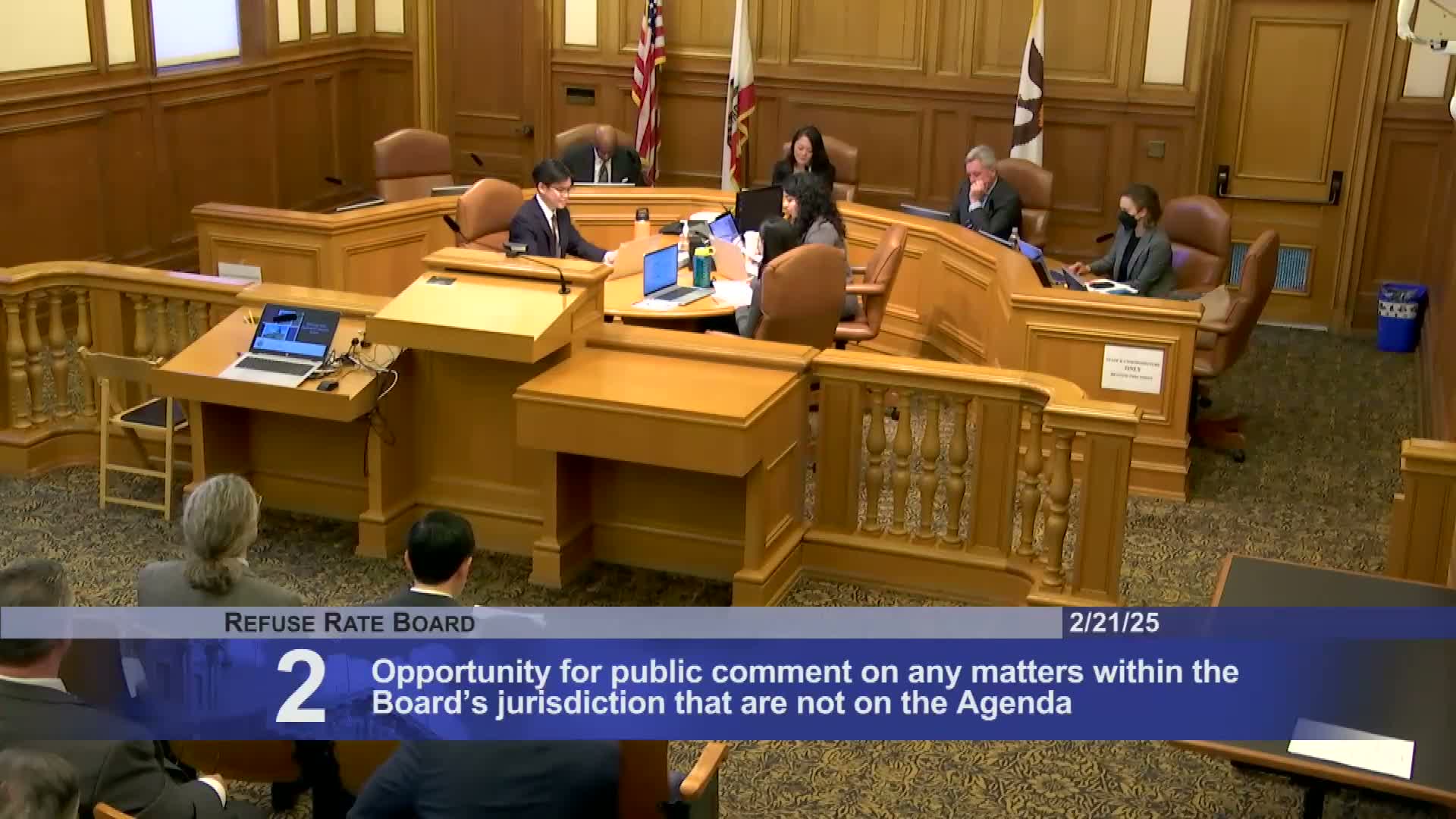
Recology San Francisco presented a three-year rate application that would raise residential and commercial collection rates to address a multi-million dollar shortfall, fund program enhancements and create a capital reserve; the refuse rate board and outside consultants pressed the company for more detail on corporate allocations, a proposed trash‑processing facility and camera-based enforcement pilots. (No votes were taken.)
Recology San Francisco asked the Refuse Rate Board on a discussion item to approve a three‑year rate application covering rate years 2026 through 2028 that would take effect Oct. 1 and would raise customer bills to cover realized shortfalls, inflation, a new business tax and targeted program enhancements.
The application is driven, Recology said, by a one‑time true‑up and slower‑than‑expected revenue recovery from the prior cycle. Rich Lancer, region controller for the San Francisco operating companies, told the board that Recology expects a combined shortfall of about $27.4 million and a balancing‑account shortfall of $13.7 million that is a primary driver of the first year's increase. Lancer gave examples of customer impacts: he said a single‑family basic service bill would rise from $47 to $55.55 under Recology's proposal.
Refuse Rate Administrator Jay Liao and his staff framed the process the board will follow: the office plans to issue a refuse rate administrator's report on May 1 and a proposed rate order on May 9, which will trigger a 30‑day clock for the board's hearing on the proposed order and the Prop 218 protest process. Liao said the controller's office has closed many interrogatories but still has important outstanding questions about corporate allocations, post‑collection costs and capital reserve justifications.
Recology also proposed service‑side investments and program changes intended to improve street cleanliness and diversion, including three new afternoon abandoned‑material sweep routes (an estimated $700,000 annually), expanded camera programs for overload and contamination detection, a revived citywide compost giveaway and an optional municipal solid waste (MSW) processing facility on a contingent schedule. Evan Boyd, region vice president for Recology, said the company designed the application to lengthen replacement schedules for nearly 60 frontline vehicles and to set aside a modest capital reserve to smooth future 0‑emission vehicle and facility modernization costs.
Outside consultants and department staff pushed back on specific proposals and analytical gaps. Rob Hilton, president of HF&H Consultants, urged caution on building a city‑owned MSW processing plant, citing failed or troubled projects in other municipalities and technical and permitting risks; he recommended continuing third‑party merchant piloting and scaling slowly, focusing on organics‑rich loads. "Don't yet commit to building your own facility," Hilton said, recommending pilot scale at 20 to 25 tons per day.
On camera programs and automated overage enforcement, HF&H flagged staffing ratios, false positives from current object‑recognition systems, customer dispute risk and the potential for litigation if charges are applied prematurely. Hilton said some programs in other cities produced false positives and class‑action threats and recommended withholding charges until accuracy exceeds a high threshold and the city sets guardrails. "Until you get that better than a 90% accuracy rate, I would not start charging people," he said.
Recology representatives responded that overage charges exist today under a manual process and the cameras would automate documentation and provide photo evidence with timestamps; Evan Boyd noted the company is open to phased approaches and further discussions with HF&H and the refuse rate administrator. "Overage charges exist today manually," Boyd said, adding that automation is meant to streamline documentation rather than immediately expand charging.
On zero‑emission vehicles and capital planning, HF&H and Recology both stressed infrastructure and cost uncertainty. HF&H warned that heavy‑duty ZEVs require large power upgrades and recommended prioritizing lower‑cost compliance options and phasing purchases. Recology said full frontline electrification could require on‑site upgrades that are substantial, including multi‑megawatt power needs.
The board and staff asked Recology and department partners for additional written materials and clarification. Jay Liao said his office is still validating third‑party actuarial and capital reports and will continue interrogatories; several board members requested written copies of presentation slides and underlying assumptions. No formal votes were taken. The refuse rate administrator's report and proposed rate order remain scheduled for the spring calendar, with further hearings to follow.