
Baltimore council reviews first month of Strengthening Renters Safety Act as residents describe hazardous conditions
Get AI-powered insights, summaries, and transcripts
Subscribe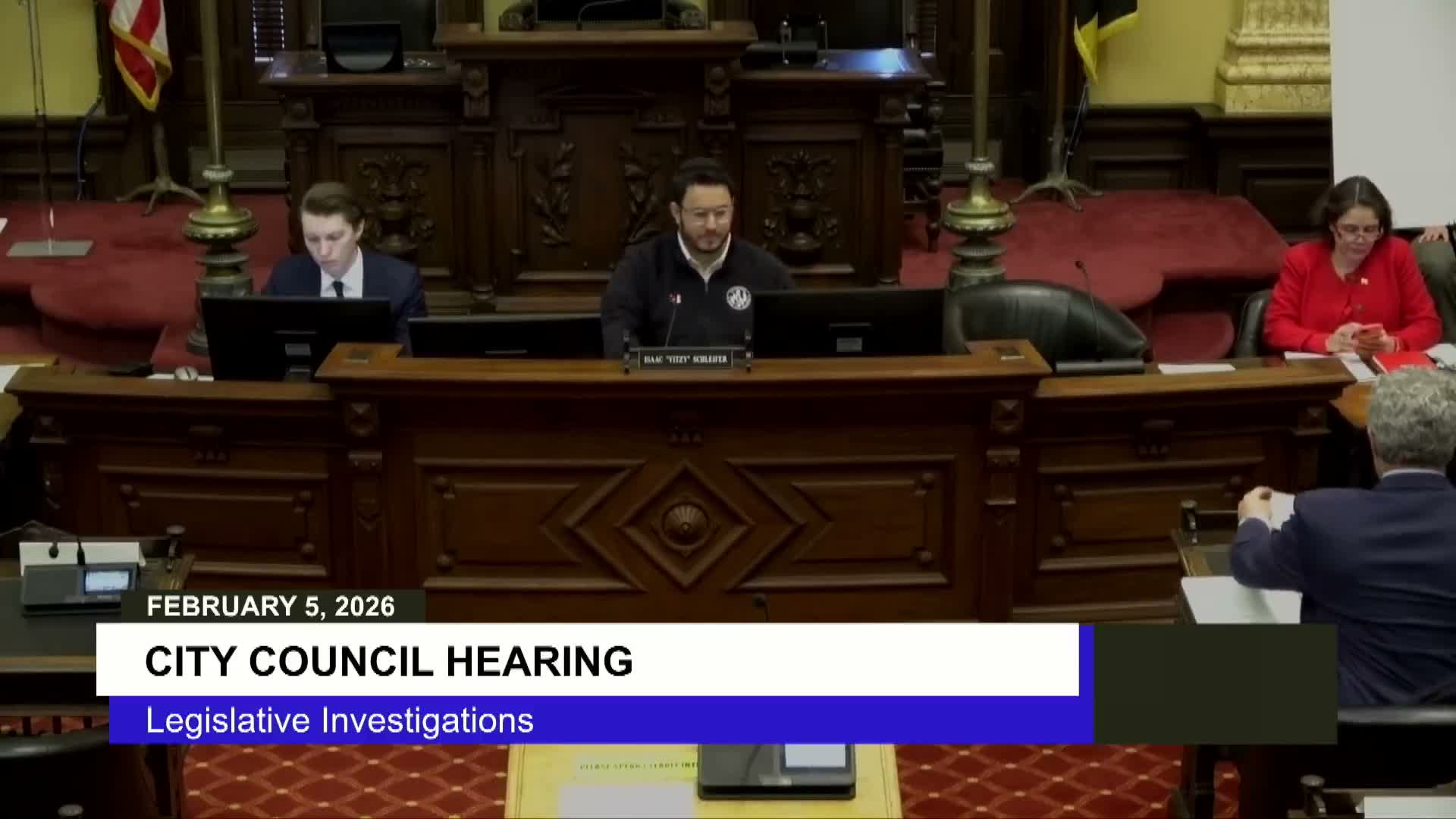
Summary
City housing officials told council members they identified 38 ``priority dwellings'' under the new law and have scheduled meetings and two rounds of inspections; residents and tenant attorneys warned the department may be failing to enforce code in practice and urged faster action at properties including Hanover Square.
Baltimore City Council members convened an oversight hearing on Feb. 4 to review implementation of the Strengthening Renters Safety Act, a new local law that directs the Department of Housing and Community Development (DHCD) to identify and prioritize buildings with repeated health-and-safety failures.
DHCD Deputy Commissioner Jason Hessler told the Legislative Investigations Committee that the department ran the law’s criteria against 2025 data and identified 38 properties that meet the statute’s threshold for ``priority dwellings.'' Under the law, buildings with 20 or more units become priority dwellings if they meet two of four criteria: an open violation notice older than 90 days; four or more violation notices in a calendar year; a high ratio of life/health-related 311 calls relative to the building size; or a HUD INSPIRE reinspection score of 79 or below. Hessler said DHCD mailed and hand-delivered notifications, added a map layer and website content listing the 38 properties, and plans meetings with owners in February and March followed by two rounds of special priority inspections (Feb–May and June–Oct).
Hessler said the law expanded the department’s citation authority for certain violations and that DHCD is coordinating with the Environmental Control Board and the city’s payment systems so fines and hearings can be tracked. Tenants can request anonymous inclusion of their unit in a priority inspection via 311, he said.
Advocates and residents praised the law’s aims but told the committee they fear implementation will be weak. Caroline Tripp, a housing attorney at Maryland Legal Aid, presented inspection logs and photographs from a property on the new list that showed more than 100 violations in August 2025 but—she said—were later marked as abated by DHCD during an October reinspection even though the conditions she and council members observed in November remained unchanged. "They showed that on October 2 the same inspector returned to the home, took a picture with his clipboard covering the damaged area and wrote down 'stove oven door gasket repaired,'" Tripp said.
Multiple Hanover Square residents described persistent failures at their building: broken elevators, repeated bedbug and roach infestations, unplowed access ramps, malfunctioning laundry rooms and intermittent heat and hot water. Resident Rashida Shavers told the council her ceiling collapsed multiple times between 2022 and 2025 and that she had experienced an assault and months-long delays in repair: "I did submit videos of being stuck on the elevator for 30 minutes," she said. Lawrence Horton, who said he lives at 911 Sharp/Leadenhall, described security lapses that left seniors and disabled veterans isolated.
Council members pressed DHCD for concrete resident-facing changes. Council President Z. Cohen asked, "What should residents expect in really clear terms?" DHCD answered that meetings with owners are mandatory, interior inspections will be scheduled, owners must present abatement plans and the department will follow up with priority inspections and, where necessary, citations. DHCD also confirmed the agency will publish an annual report (the department said a light report is due May 1 with a fuller report in 2027) and will work with the council on clearer public access to the Priority Dwelling list and communications encouraging anonymous 311 reporting.
Members raised capacity concerns. One councilmember noted DHCD staff historically discussed an ideal inspector workforce in the hundreds; DHCD said the agency needs to evaluate the total workload created by the new law before specifying a hiring target but acknowledged the department will require more inspection capacity to meet the mandate. Several council members and advocates said the city should also pursue property receivership legislation to transfer problem properties to third-party managers when owners fail to remediate; a related bill was described as already in progress.
The hearing produced no formal votes. DHCD committed to staying after the hearing for individual tenant follow-ups, to circle back on a reported water outage at one property (Palmer Place), and to provide more detailed data to the council about how properties were placed on the Priority Dwelling list. Residents were urged to continue calling 311 and to document complaints and interactions with housing inspectors and management.
The committee recessed after the session; DHCD said it has scheduled meetings with owners and expects the first round of priority inspections to begin in February. The council indicated follow-up oversight, data requests and additional hearings would continue as implementation proceeds.