
Perry adopts emergency stormwater ordinance to require one‑time development impact fees and design standards
Get AI-powered insights, summaries, and transcripts
Sign Up Free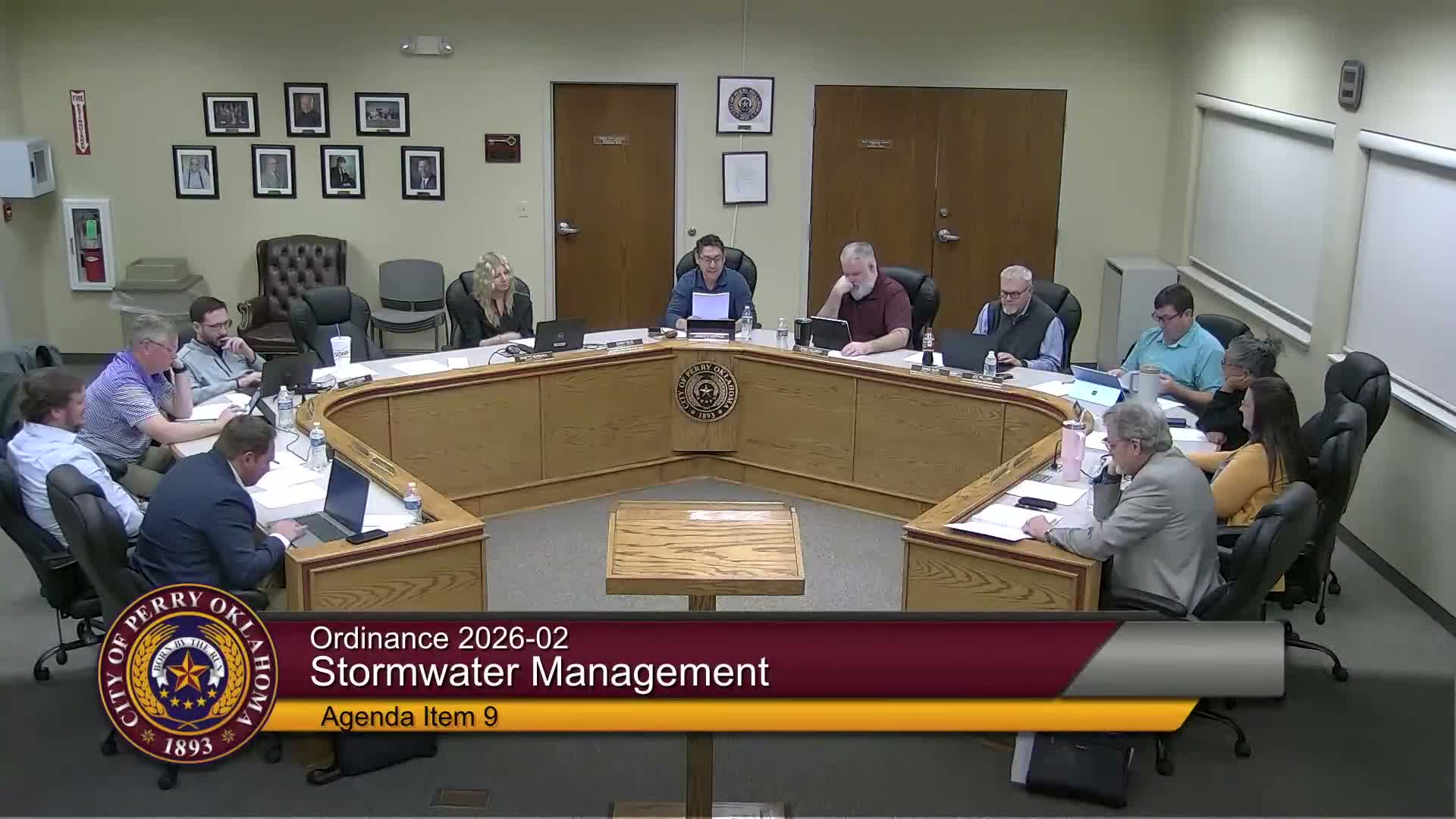
Summary
The Perry City Council adopted an emergency stormwater ordinance (Ordinance No. 2026‑2) requiring one‑time impact fees for new development, preserving the existing $3 monthly drainage charge for current customers, and establishing local drainage design standards; the emergency clause was also approved.
PERRY — The Perry City Council on Wednesday adopted an emergency ordinance establishing a formal stormwater management system for new development and a one‑time impact fee based on impervious surface area.
Lawrence, presenting the ordinance to the council, said the measure has three purposes: to create an impact fee for new businesses tied to equivalent service units (impervious surface); to preserve the existing $3 monthly drainage charge for current residents and businesses; and to establish local design standards the city can enforce on developers. "The purpose of this ordinance is threefold," Lawrence told the council during the presentation.
Under the ordinance, new developments would pay a one‑time impact fee when they submit plans for construction. Staff provided sample calculations during the meeting: an EZ Drill parking‑heavy project would carry an estimated $1,200 one‑time charge, a Budweiser building example was listed at roughly $1,600, and a Crow Industrial Park example ran about $7,000. Lawrence said those are example calculations used to show scale and that fees can be offset if mitigation is installed during construction.
Council members pressed staff on the master drainage plan referenced in the ordinance. Staff said adopting the ordinance does not allocate money or create positions to produce a full master plan immediately; rather, it creates a framework the city can use and build on over time. "It might take years to get done in a small town like this," staff said, adding the ordinance is meant to codify design standards and give the city a consistent way to require and evaluate drainage solutions.
The council voted to adopt Ordinance No. 2026‑2 on a roll‑call vote and later approved the ordinance's emergency clause, making the new rules effective immediately for future development. Council members emphasized that the ordinance does not change the monthly $3 drainage charge for existing customers — the new charges apply only to new development or projects that increase impervious surface.
City staff said next steps include publishing guidance for developers, finalizing the ordinance language for codification in Chapter 17, Article 7 of the Perry Municipal Code, and incorporating the new design standards into plan review. Implementation of any large‑scale master drainage planning work would be considered in future budget cycles.
Councilmembers and staff noted the ordinance is intended to give Perry a locally enforceable standard for drainage and to generate funding to mitigate the impacts of new development without increasing the monthly charge paid by existing utility customers.
The ordinance was adopted by the council on a roll‑call vote; the emergency clause was approved in a subsequent roll‑call vote.