Get Full Government Meeting Transcripts, Videos, & Alerts Forever!
Get email alerts on the Municipal Service Review topic
No spam. Unsubscribe anytime.
LAFCO circulates draft municipal service reviews for Woodside and Portola Valley; flags sheriff contract and sewer capacity risks
Summary
San Mateo County LAFCO approved circulation of draft municipal service reviews for Woodside and Portola Valley, highlighting a sheriff-contract-driven budget gap, sewer treatment and service‑area constraints in Woodside, and Portola Valley’s structural deficit and proposed real‑estate transfer tax to raise revenue.
The San Mateo Local Agency Formation Commission on Nov. 19 voted to circulate draft municipal service reviews (MSRs) and sphere‑of‑influence updates for the Town of Woodside and the Town of Portola Valley and directed staff to schedule final hearings on Jan. 21, 2026.
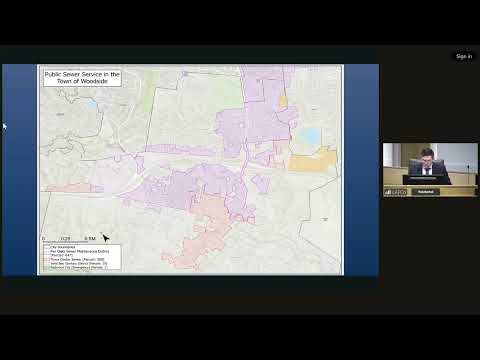
Rob Bartoli, LAFCO executive officer, told commissioners that Woodside’s general fund is currently balanced but faces an approximate $1,000,000 gap in fiscal years 2030–31 tied to rising costs in its contract for sheriff services. Bartoli said the town is largely on on‑site septic systems and that sewer service relies on limited treatment allocations from Silicon Valley Clean Water in Redwood City via agreements with Fair Oaks County Sewer Maintenance District and West Bay Sanitary District. “There is a finite amount of sewer that the county can provide within this area,” Bartoli said, and he recommended a town‑wide or area‑specific sewer feasibility study and continued coordination with Fair Oaks and the county.
Jason Ledbetter, Woodside town manager, said the town has begun a sewer‑capacity and master‑plan study and gave preliminary daily capacity figures for existing service areas: “within the town center we can do 100,000 gallons a day, and then within our other sewer service area it’s 150,000 gallons a day,” and he said some candidate housing sites (High Road and a West‑of‑280 Raymundo location) appear feasible to serve but will require engineering and funding.
Portola Valley’s review shows a longer history of structural deficit. Bartoli said the town’s sheriff contract rose about 59% for the 2023–25 period and is the largest driver of increasing costs; without new revenue the town’s reserves are projected to be depleted by FY 2029–30. Portola Valley town manager Darcy Smith told the commission that sales tax receipts are small (about $325,000 annually) and a parcel tax analysis showed a prohibitively high per‑parcel amount to reach the revenue target. She said a real‑estate transfer tax of $10 per $1,000 of sale price — the option the town surveyed — would generate “approximately $2,000,000 per year.” Smith said the town is studying a charter‑city approach to authorize that tax and aims to place the measure on the ballot in 2026 if the town council proceeds.
On governance options — consolidation, annexation, disincorporation or formation of a service district — Bartoli emphasized LAFCO staff is presenting options discussed locally and “LAFCO has no recommendation about any of these actions.” All options would require further fiscal analysis and, where applicable, elections and LAFCO proceedings.
Votes at a glance: the commission voted to accept and circulate the draft MSRs for public comment, and separately voted to direct the executive officer to schedule the final public hearing for both towns on Jan. 21, 2026; the consent agenda and those motions passed by roll call.
Why it matters: both towns are largely residential and rely heavily on property tax; rising contract costs for sheriff services have outpaced local revenue and are forcing towns to consider service changes, interjurisdictional agreements and new local revenues. The draft MSRs recommend targeted sewer studies, continued interagency coordination, and further budgetary analysis before any governance changes would be pursued.
Next steps: LAFCO staff will circulate the drafts to affected agencies, schedule virtual workshops and present the final MSRs and sphere‑of‑influence updates for consideration at the Jan. 21, 2026 meeting.