Get Full Government Meeting Transcripts, Videos, & Alerts Forever!
Get email alerts on the Emergency Services Sales Tax Grant topic
No spam. Unsubscribe anytime.
Council directs staff to draft ordinance for emergency services sales tax grant after oversight debate
Summary
After debate over council oversight and eligibility, staff were asked to advertise a five-member advisory board and return with an ordinance to run a grant using 5% of anticipated emergency services sales tax revenue (about $840,000 at current estimates for 2026).
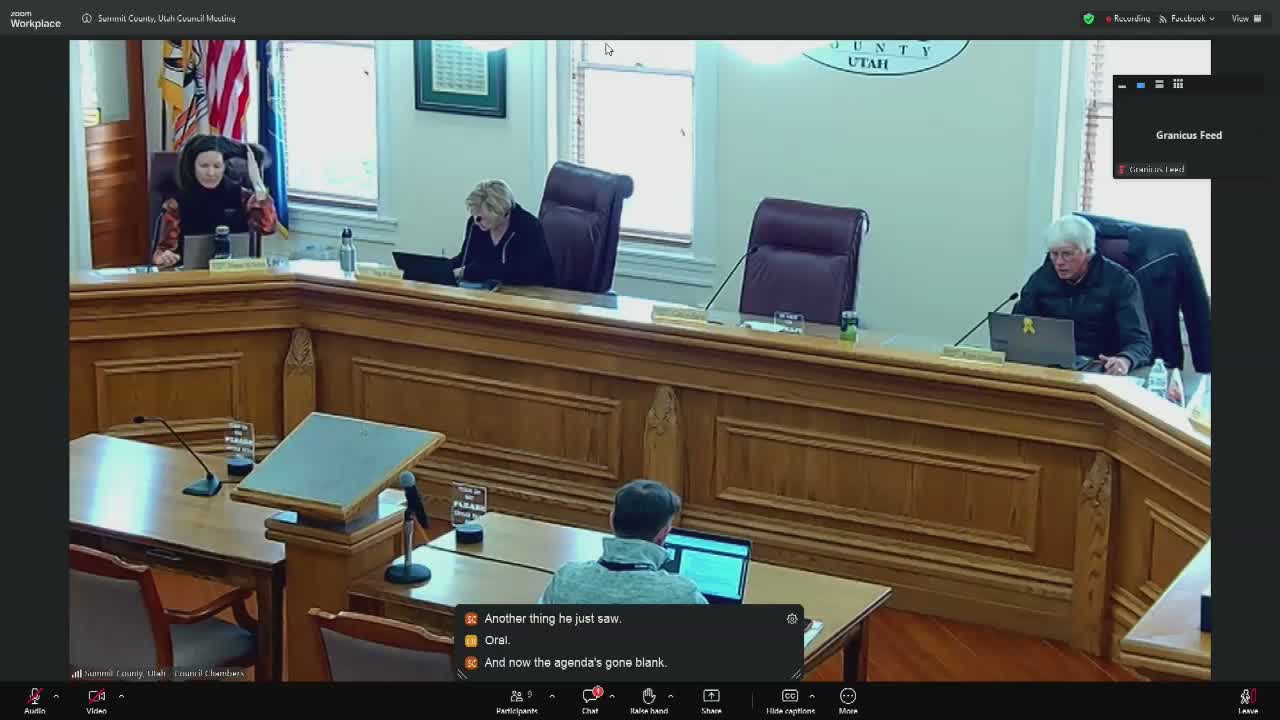
Summit County Council members on Feb. 4 endorsed moving forward with a staff-led grant program funded from the emergency services sales tax, but not before a sustained debate over how much direct oversight the council should retain.
County staff told the council the FY26 budget includes a grant pool funded by the emergency services sales tax and that the county manager’s executive order would establish a five‑member advisory board to recommend awards. "We anticipate [2026 collections] would be about 16,000,000 in collections," a staff presenter said, adding that 5% of that figure is roughly $840,000 available for grants.
Staff described the intended purpose as one-time, capital or equipment funding for organizations that qualify under the EMS statute — organizations such as fire districts, law enforcement, EMS, search and rescue, solid‑waste authorities and the Utah Avalanche Center. Staff emphasized the grant should not be used for ongoing personnel costs.
Council members praised the principle of the grant as a way to distribute visitor‑driven sales revenue but clashed over governance. Several members said they wanted “citizen eyeballs” on the process and argued for council advice‑and‑consent on the manager’s appointees and council approval of final allocations. Others said creating a staff‑run advisory board would be faster and avoid putting the council into hours of applicant interviews.
"I would want the advice and consent of the council for the manager's appointees," one council member said, urging a compromise that preserves council oversight while allowing staff to operate efficiently. Another member argued grants should prioritize county‑based organizations and recommended scoring criteria and public reporting on awards.
Staff said they would start advertising vacancies and will return in the coming weeks with an ordinance amending county code to define eligible applicants (e.g., county departments, fire districts, Park City Police), the advisory‑board structure and the application timeline. The council did not take a formal recorded vote at the meeting; staff characterized the discussion as direction to proceed with drafting and outreach.
Next steps: county staff will draft and bring an ordinance back for the council to review, refine and formally adopt before opening the application period.