
Clay County staff use budget simulation to show how proposed state bills could cut local services
Get AI-powered insights, summaries, and transcripts
Subscribe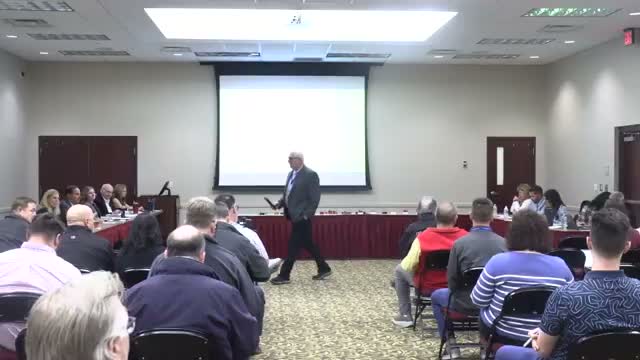
Summary
County staff demonstrated a budget simulation showing how proposed Florida legislation — including HB 203 — could reduce ad valorem revenue and force trade-offs across personnel, reserves and local services. Commissioners asked for early guidance and voter education materials.
Clay County staff on Thursday used a color-coded "chip" simulation to show commissioners and the public how proposed state legislation could shrink the county's ad valorem revenue and force choices about services, staffing and reserves.
The simulation, presented by county finance staff, treated the $801,000,000 current-year budget as a set of funds and revenue sources and walked participants through scenarios in which changes to property-tax rules and additional homestead or phase-in exemptions reduce taxable value. "This is our kickoff to our budget season," Speaker 2 said, noting staff would email the GDC presentation link and make it available online. "It allows the participant ... to take the revenue and put them in the particular funds that are there," he said.
Why it matters: Commissioners and staff said the magnitude of potential revenue loss could require cuts to services many residents consider essential. Staff pointed to statutory reserve requirements (5% holdback) and a best-practice general-fund reserve of 16.7% as constraints on how much can be reallocated. "We started practicing for this to really understand what the impacts would be," Speaker 2 said.
Staff laid out numeric examples to illustrate the trade-offs. Using an optimistic 8% growth assumption for taxable value, staff said that growth would represent roughly $13.4 million in available revenue under that scenario, but reserves, statutory holdbacks and small shifts in taxable value can erase much of that cushion. Speaker 5 presented the full budget and said the workshop would focus on revenues supported by ad valorem: general fund, municipal service units (MSUs) for law enforcement and fire, and unincorporated area MSUs.
Commissioners asked detailed questions about where discretion exists in the budget. The simulation showed which funds are locked (for example, portions that fund sheriff and fire MSUs) and which are discretionary. Speaker 5 said the sheriff's and fire MSUs are funded by splits that can require general-fund supplementation if MSU revenue falls. "So right off the front, if that represents our 5%, then our second box, our black box, it shows what our reserves are," he said.
Legislative context: Commissioners and staff discussed bills from Tallahassee, including HB 203. Speaker 8 summarized testimony he heard in Tallahassee and said proponents argued counties could absorb cuts by trimming services. "The intention is that there is a belief that counties are bloated enough that they can cut these services," he said. Speaker 9 warned that if the bills pass, they will likely go to the ballot via joint resolution and that the county must prepare voter-education materials to explain what would be lost. "I would love to pay less on my property taxes, but I want to know what I'm giving up for that," Speaker 9 said.
Public concerns and public-safety context: Several public commenters urged clarity on what would replace lost property-tax revenue and cautioned that deep cuts could reduce services or force municipal consolidation. A longtime resident and county official said Clay County is "lean," and the Clay County Sheriff's Office representative reported the department is about "40 or 50 deputies short" of a state average, adding current 911 response times are about 10 minutes and could lengthen if staffing falls.
Next steps: Staff sought early direction so department budgets can be prepared; commissioners said they will continue discussions and that county representatives plan to stay engaged in Tallahassee. The presentation will be posted online and staff said they are available for follow-up questions.
"We wanted to be ahead of this," Speaker 2 said. "We're just looking for guidance."