Georgia House approves infant safe‑surrender devices, expands feral‑hog controls and clarifies magistrate court fees
Loading...
Summary
On Feb. 3, 2026 the Georgia House of Representatives passed three bills after debate: HB 350 authorizes installation and operation standards for infant safe‑surrender devices; HB 946 expands tools to control invasive feral hogs, including limited drone use; HB 999 clarifies magistrate court technology fee authority and fixes a drafting error.
The House of Representatives on Feb. 3, 2026 approved three bills addressing child safety, invasive wildlife and court fees.
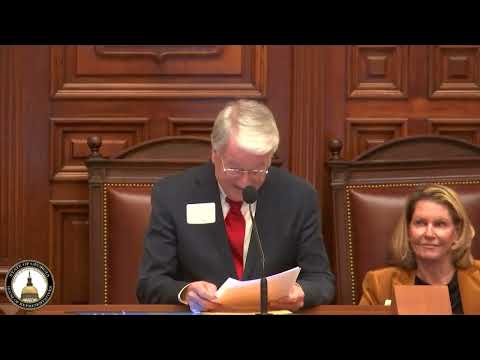
Representative Mike Cameron introduced House Bill 350, saying the measure "will allow the installation of infant safety devices in the state of Georgia." Cameron described how the devices would work at designated sites such as fire stations or medical facilities: an alarm would notify emergency personnel when a newborn is placed inside, routine checks would be required twice daily, monthly alarm verification would be required, and the Department of Human Services would be notified and take custody within six hours for follow‑up care. After members asked about anonymity and operational safeguards, Cameron said the statute allows someone surrendering a child to remain anonymous. The House approved the bill by voice/vote; the clerk reported the yeas 168, nays 0.
Representative Chaz Clifton presented House Bill 946 to broaden legal options for landowners and hunters seeking to reduce feral hog damage. Clifton said the bill removes certain licensing and permit requirements for taking feral hogs on private property, permits taking hogs from a motor vehicle on private land under the bill’s terms and explicitly allows use of unmanned aircraft systems to locate hogs. "We're not killing them with drones. We're just using them to locate feral hogs," Clifton said. Lawmakers cited a University of Georgia Extension estimate of about $150,000,000 in annual agricultural damage as part of the rationale for the measure. After questions about wildlife and coastal impacts, the House passed the bill; the clerk recorded yeas 160, nays 1.
Chairman Jim Levitt presented House Bill 999, saying the measure clarifies that magistrate courts may assess technology fees authorized by local law and corrects a repealer in prior legislation so the repeal would apply only to specified probate provisions rather than the court provisions broadly. Levitt summarized the bill as a fix to allow courts to fund technology costs through assessed fees rather than county taxpayers. The House passed HB 999 with the yeas 160 and nays 4.
Several other bills were read for first and second reading during the session and a set of privileged resolutions and recognitions were adopted. The House adjourned until 10:00 a.m. on Wednesday, Feb. 4, 2026.