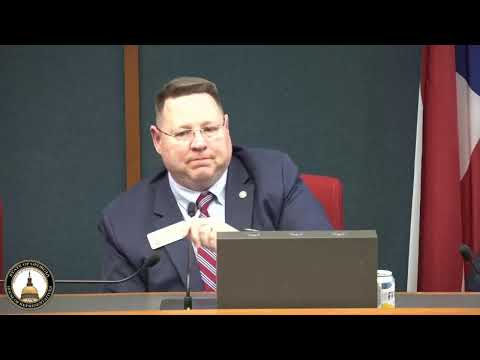
Presenters ask Georgia House committee to fund $750,000 pilot to prepare Guard members’ VA claims
Loading...
Summary
Founders of VetScore asked the House Defense of Veterans Affairs Committee to sponsor a two‑year pilot for up to 450 Georgia National Guard members to prepare VA disability claims for free, citing about 700 reviewed claim issues and a reported 92% 'first pass' accuracy rate; lawmakers pressed presenters on costs, staffing and AI safeguards.
Nelson Rouleau, co‑founder of VetScore, told the Georgia House Defense of Veterans Affairs Committee on Monday that his group wants the state to sponsor a two‑year pilot to help currently serving Georgia National Guard members prepare accurate VA disability claims at no cost to the service member.
Rouleau said the pilot would cover up to 450 Guard members and cost about $1,667 per member — roughly $750,000 over two years — under a sponsor model that removes fees for families. "The service member never pays. No hidden cost. No fees. Not today. Not ever," Rouleau said during the presentation.
Why it matters: Committee members pressed presenters on whether the platform would add complexity for already‑burdened VA reviewers and how the state would measure return on investment. Supporters argued earlier in‑service documentation reduces downstream appeals, rework and waits that burden veterans and the VA.
Rouleau described VetScore’s mission as improving documentation quality prior to formal VA review, using structured human review plus an AI‑assisted checklist. He said the organization had supported documentation for about 700 claim issues and observed a roughly 92% "first pass" rate on those items, meaning submitted claim packets aligned with available medical evidence when first reviewed by the VA, not that ratings or payments automatically increased. "We don't mean more claims. We don't mean higher ratings," he said.
Marcus Smith, VetScore’s chief technology officer, told the committee the team is building conservative safeguards around AI and that humans review every record. "We have a private LLM, our own training models, and we look at every single record that comes in right now," Smith said, adding that, in the program’s early phase, one staffer can handle about 20 service members when supported by the software.
Several lawmakers asked whether the software could help veterans who have already separated. Rouleau said the current product is focused on those still serving because records can be corrected before separation; supporting separated veterans is an eventual goal but not the current ask. "Right now, our software ... cannot help veterans," Rouleau said.
Lawmakers also sought more specificity about cost assumptions and economic benefits to the state. Rouleau and Smith offered to provide the committee with pricing models and return‑on‑investment projections, and they said VetScore has governance and privacy advice from Holland & Knight and research support from Stanford University.
What didn’t happen: The committee received the presentation and asked questions but took no formal vote or funding action. The chair closed the hearing and adjourned the committee after questions concluded.
Next steps: Presenters said they would follow up with ROI and pricing details for committee review; the committee did not set a date for further action.