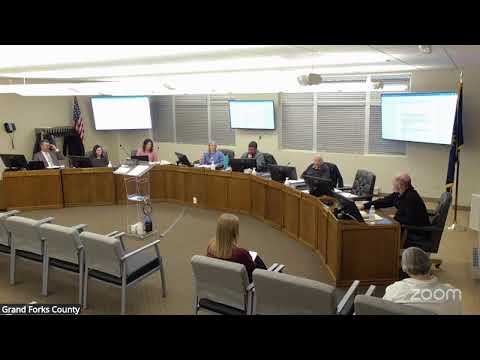
County hears overview of Grand Forks Air Force Base compatible-use study
Loading...
Summary
Consultant Casey Bartholomew outlined a federally funded, community-led compatible-use study for Grand Forks Air Force Base that will run about a year, produce recommendations (not mandates), and include public engagement and a mid-study tabletop exercise.
Casey Bartholomew, with Matrix Design Group, told the Grand Forks County Commission on Feb. 3 that a federally funded compatible-use study for Grand Forks Air Force Base will be community-led, data-driven and nonregulatory.
“It's not a directive or mandate,” Bartholomew said, describing the project’s aim to identify compatibility issues that could affect the long-term sustainability of the Air Force mission and to support regional development initiatives that are compatible with that mission. He said the study’s end state will be “a report and an actionable strategy” including prioritized development actions and a communication coordination manual for stakeholders.
Bartholomew said the project team held an advisory committee kickoff and will begin a discovery and analysis phase immediately, followed by public engagement. He told commissioners the study is scheduled to run about one year, with a progress review roughly halfway through and final deliverables toward the end. He also said the project will include a tabletop exercise—an approach more commonly used in military installation readiness reviews—to test coordination among stakeholders.
In response to questions from the commission, Bartholomew gave his background as a Grand Forks native and a retired Air Force mission support group commander who joined Matrix Design Group after 24½ years of active duty. He said the study team collectively has more than 75 years of Air Force experience.
Bartholomew said the advisory committee includes city, county and other agency stakeholders and that the team has not yet finalized which peer communities it will visit; potential peers under consideration include Wright-Patterson AFB (Ohio), Fort Huachuca (Arizona) and Nellis AFB (Nevada). He said the selection of peer communities will follow the discovery phase so the team can choose peers facing similar compatibility issues.
The commission did not take action on the study at the Feb. 3 meeting; Bartholomew said a project website and public-engagement opportunities should be available by the end of the month.