Get Full Government Meeting Transcripts, Videos, & Alerts Forever!
Get email alerts on the Lpp Guidelines topic
No spam. Unsubscribe anytime.
CTC staff outline 2026 updates to Local Partnership Program, reaffirm $200M annual appropriation
Summary
Transportation Commission staff walked stakeholders through proposed clarifying edits to the Local Partnership Program guidelines for the 2026 cycle, explained eligibility and funding splits ($200M annual appropriation; 40% competitive / 60% formulaic), and set a tentative timeline for adoption and applications.
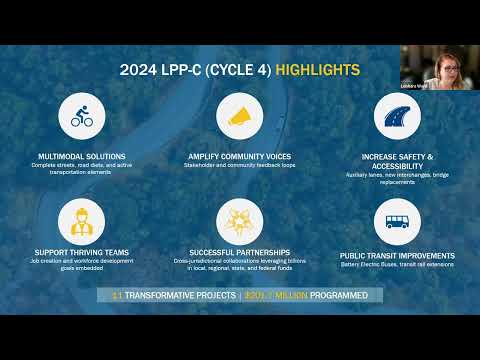
Associate Deputy Director Lashara Ward said the Local Partnership Program (LPP) exists to ‘‘provide funding to counties, cities, districts, and regional transportation agencies that have voter approved taxes, or fees dedicated solely to transportation improvements.’’ Ward told workshop attendees the program’s annual appropriation is ‘‘the 200,000,000 annual appropriation’’ and that $20 million is set aside for agencies with new or renewed voter‑approved transportation initiatives; the remainder is split roughly 40% to the competitive program and 60% to the formulaic program.
Staff described the two tracks: the formulaic program serves ‘‘self‑help’’ agencies with a voter‑approved transportation sales tax and is able to program funds earlier in the cycle, while the competitive program accepts nominations and evaluates applications through a multi‑month review process. Ward said the Commission typically adopts draft guidelines in summer and final guidelines in August, with applications due in late November and evaluations running into the following year.
Kayla Giese, assistant program manager for LPP, summarized current balances and appendix references for formulaic agencies: ‘‘we currently have 46 eligible agencies’’ (listed in appendix C of the formulaic guidelines), with roughly $20 million available through 06/30/2026 in the 2022 cycle and about $89 million available through 06/30/2028 in the 2024 cycle. Staff said unused incentive funds and lapsed project funds are sometimes recycled into later cycles, which helped the Commission program above the usual competitive allotment in the last round.
On program priorities and evaluation criteria, Ward said staff plan clarifying edits rather than large policy shifts. Updates noted for 2026 include an expanded equity supplement to promote community engagement and equitable outcomes (staff named Beverly Newman as leading that work), stronger workforce‑development language (Navin Habib referenced), and tightened guidance on land‑use efficiency and pro‑housing criteria developed in coordination with the Department of Housing and Community Development to help applicants demonstrate how projects support transportation‑efficient land use.
Staff emphasized that the guideline edits are intended primarily to improve clarity for applicants and reviewers; they repeatedly described the changes as clarifying edits rather than new program policy. The workshop materials and slide deck will be posted to the program web page within days of the workshop for stakeholder reference. The Commission’s next steps are additional workshops, office hours for one‑on‑one assistance, and posting a registration form for appointments on the LPP page.