Get Full Government Meeting Transcripts, Videos, & Alerts Forever!
Get email alerts on the Iran topic
No spam. Unsubscribe anytime.
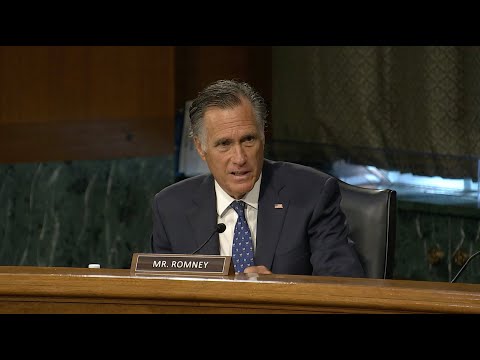
Romney urges congressional up-or-down vote on any Iran deal; secretary warns breakout time "down to a matter of weeks"
Summary
Sen. Mitt Romney urged the administration to send any Iran nuclear deal to Congress for an up-or-down vote and argued that a strong, costly response is needed. The secretary replied that the previous agreement had extended breakout time to about a year and that, after the U.S. withdrawal, Iran—an produce fissile material in a matter of weeks.
Senator Mitt Romney pressed the administration to take a firm stance on Iran nd to seek congressional approval of any agreement, saying Tehran appears "hell bent on having a nuclear weapon" and that the U.S. should make clear the cost of pursuing one.
"I happen to believe that that Iran will be hell bent on having a nuclear weapon at some point," Romney said, urging that Washington not "lessen the cost" in negotiations and calling for "a very heavy price paid" if Iran pursues a nuclear capability.
The senator urged the administration to present any deal to Congress "for an up or down vote" to demonstrate the national interest's level of support.
The secretary responded that Washington shares the objective of preventing Iran from acquiring a nuclear weapon and argued that the previous nuclear agreement had significantly set back Iran—y constraining fissile-material production and imposing intrusive inspections.
"That agreement was working by all objective accounts," the secretary said, adding that after the U.S. withdrawal, Iran ccelerated its program and that "now, we have...the breakout time...that's now down to a matter of weeks." He warned that focusing enforcement on weaponization rather than fissile material is risky because weapon work can occur in small, hard-to-see settings.
The exchange ended with both sides agreeing on the shared objective of preventing a nuclear-armed Iran, while differing on the best path to achieve it. The hearing did not record a legislative outcome or a formal vote on the matter.