
Policy panel clarifies school‑ vs. student‑sponsored extracurriculars, forwards changes to full board
Get AI-powered insights, summaries, and transcripts
Subscribe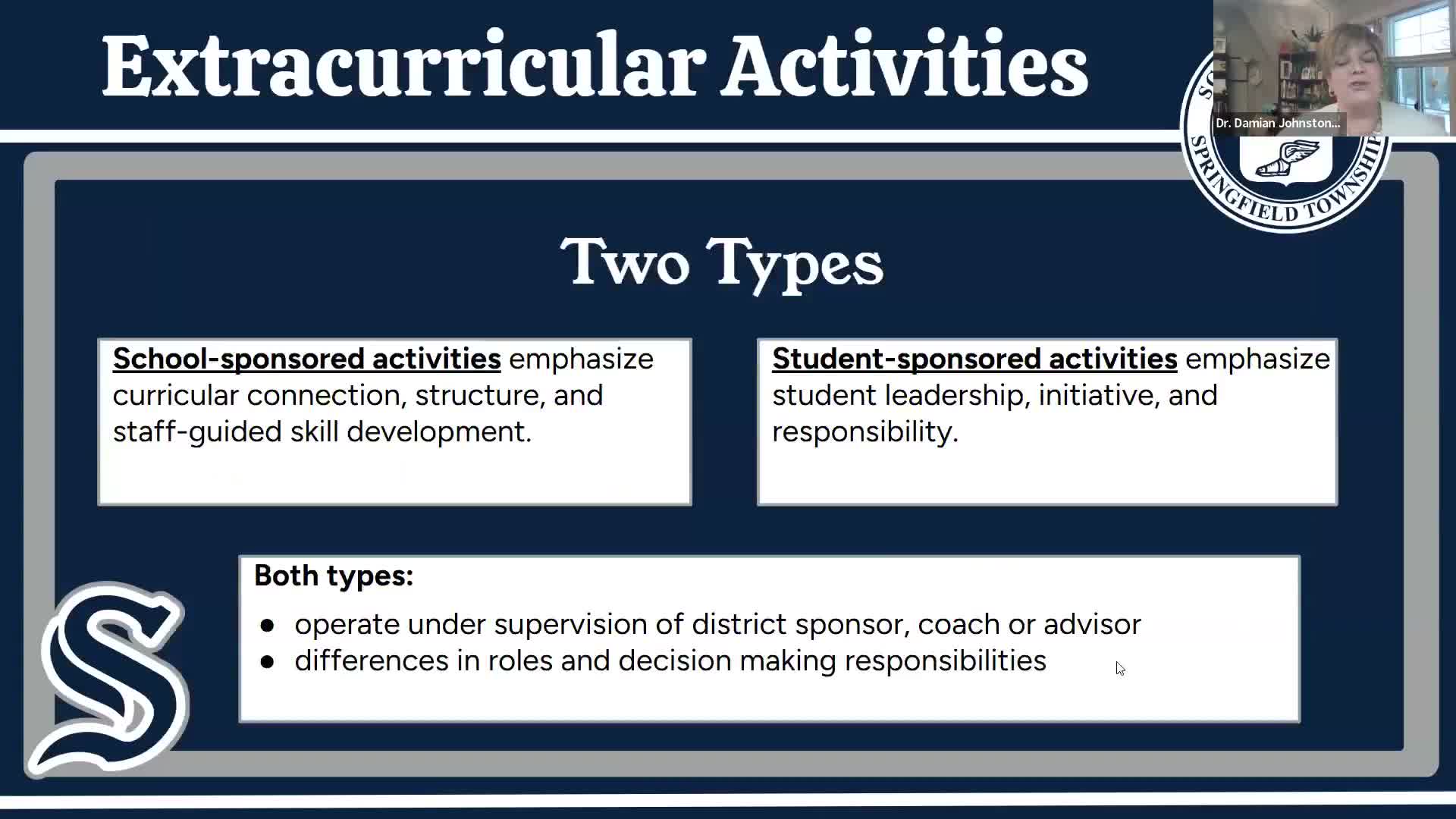
Summary
The policy committee reviewed revisions to Policy 122 to delineate school‑sponsored and student‑sponsored activities, clarify funding and supervision, and plans to forward the draft to the full board on Feb. 17 with an effective date of Feb. 18, 2026 if approved.
The Springfield Township School District policy committee on Feb. 5 reviewed revised language for Policy 122, which explicitly separates school‑sponsored extracurriculars from student‑sponsored activities and clarifies who pays for what and who supervises events.
"There are two types of extracurricular activities that we're gonna talk about. School sponsored activities and student sponsored activities," Doctor Johnson told the committee, framing the central distinction. She added that "school sponsored activities are ones that are created on behalf of the school district," which are funded through the district budget and supported with district transportation, materials and staffing.
By contrast, student‑sponsored clubs are "student‑initiated, planned and organized," Doctor Johnson said, and "the operational costs for these activities are not included in the district budget," meaning students are expected to raise funds or collect dues to cover expenses.
The draft policy presented to the committee uses color‑coded edits (additions in green, deletions in pink) and emphasizes four core areas: focus and purpose, structure and decision‑making, funding and resources, and authority. It makes explicit that an adult must supervise activities, but that assignment of a monitor does not constitute district sponsorship — a point the district solicitor recommended to avoid forcing monitors to align with a group's beliefs while still ensuring student safety.
Committee members pressed for practical clarifications. Mr. Jordan asked whether club funds are governed by the district; Doctor Johnson said many clubs do route accounts through the business office but acknowledged inconsistent past practice and the need for clearer administrative procedures so fundraising and accounts are handled uniformly.
Board members discussed how new sponsored positions are added and when a club merits district sponsorship. Doctor Johnson said new paid sponsor positions or district‑funded clubs should be proposed during the district's budget planning cycle so costs can be anticipated and included in next year's budget. Using athletics and girls' wrestling as examples, the committee debated the "critical mass" needed to justify creating or funding programs.
The draft also clarifies guest‑speaker rules and access. The committee noted that religious or affinity groups may invite guest speakers but regular attendance by outside adults requires appropriate sponsorship or approval; Doctor Johnson also confirmed that home‑educated (homeschool) resident students may participate in extracurriculars and athletics and that access is coordinated through her office.
On volunteer advisers, the committee heard that while staff sometimes volunteer to advise clubs temporarily, the district aims to reduce open‑ended volunteer sponsorships and transition toward consistent, compensated sponsorship next year to avoid inconsistent expectations and liabilities.
Committee members agreed to place the revised Policy 122 on the full board agenda for consideration at the Feb. 17 board meeting; the committee noted that, if approved on Feb. 17, the policy language would become effective Feb. 18, 2026. A recommendation was volunteered to have a committee member present the item at the board meeting and to follow up with updated activity handbooks and administrative regulations after adoption.
The meeting closed without public comment and with a procedural motion to adjourn.