
Bridgeport advocacy committee mobilizes to press state for bigger education funding increase
Get AI-powered insights, summaries, and transcripts
Subscribe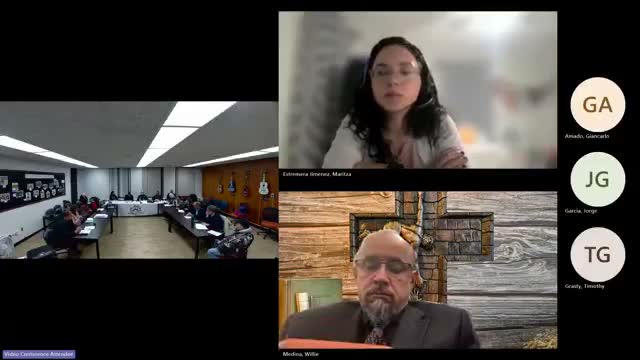
Summary
The Bridgeport School District ad hoc advocacy committee organized outreach and testimony for a Feb. 17 education committee hearing, urging lawmakers to raise the state education cost‑sharing (ECS) foundation that has not been increased in more than a decade. Members agreed on coordinated tactics — testimony training, buses to Hartford and parent outreach — to push for a larger up‑front increase.
Rob Treiber, chair of the Bridgeport ad hoc advocacy committee, told attendees on Feb. 5 that the group’s immediate task is to press the state to increase the education cost‑sharing formula and to organize testimony for a Feb. 17 education committee hearing. "We're fighting to see the ECS fully funded," Treiber said, summarizing the committee's focus.
The committee spent the meeting refining what to ask legislators and how to get community turnout. Members described competing numeric targets but agreed on the objective: to close a long‑standing funding gap. The transcript shows the current foundation amount discussed in the meeting is about $11,525 per pupil; committee members presented two advocacy targets they said they would press for — roughly $16,500 per pupil using cost‑of‑living adjustments or $17,000 if an additional racial‑equity factor is applied — while acknowledging details in the bill text were still changing.
Dr. Ross Avery, the district superintendent, said district leaders are preparing testimony, sign‑up links and materials to make it easy for parents and staff to participate. The district communications team offered a QR code and prewritten testimony templates that residents can scan and submit; the group also planned training run by a coalition called Connecticut for All to guide first‑time witnesses on how to testify.
Willie Medina, who reviewed the bill language the committee had seen, read proposed statutory changes and numbers aloud and cautioned members that bill text may be amended rapidly during the short 13‑week session. Committee members discussed targeting key legislators and committee chairs by phone and in person; several urged a strategy of concentrated outreach to influential lawmakers, including flooding one senator’s office with calls as a prior successful example.
To build visible pressure, the committee discussed mobilization tactics used previously — buses to Hartford, student testimony to secure earlier speaking slots, handwritten postcards and evening testimony slots by Zoom — and planned to coordinate schedules for people who can travel. Members agreed to use a combination of digital outreach through the district’s ParentSquare and direct community outreach.
The committee set next steps: finalize testimony templates, circulate a sign‑up link and QR code, run a testimony workshop and recruit parents, students and community partners to testify on or ahead of Feb. 17. The meeting closed after the chair took a motion to adjourn and the group ended by voice vote.