Get Full Government Meeting Transcripts, Videos, & Alerts Forever!
Get email alerts on the Labor Negotiations topic
No spam. Unsubscribe anytime.
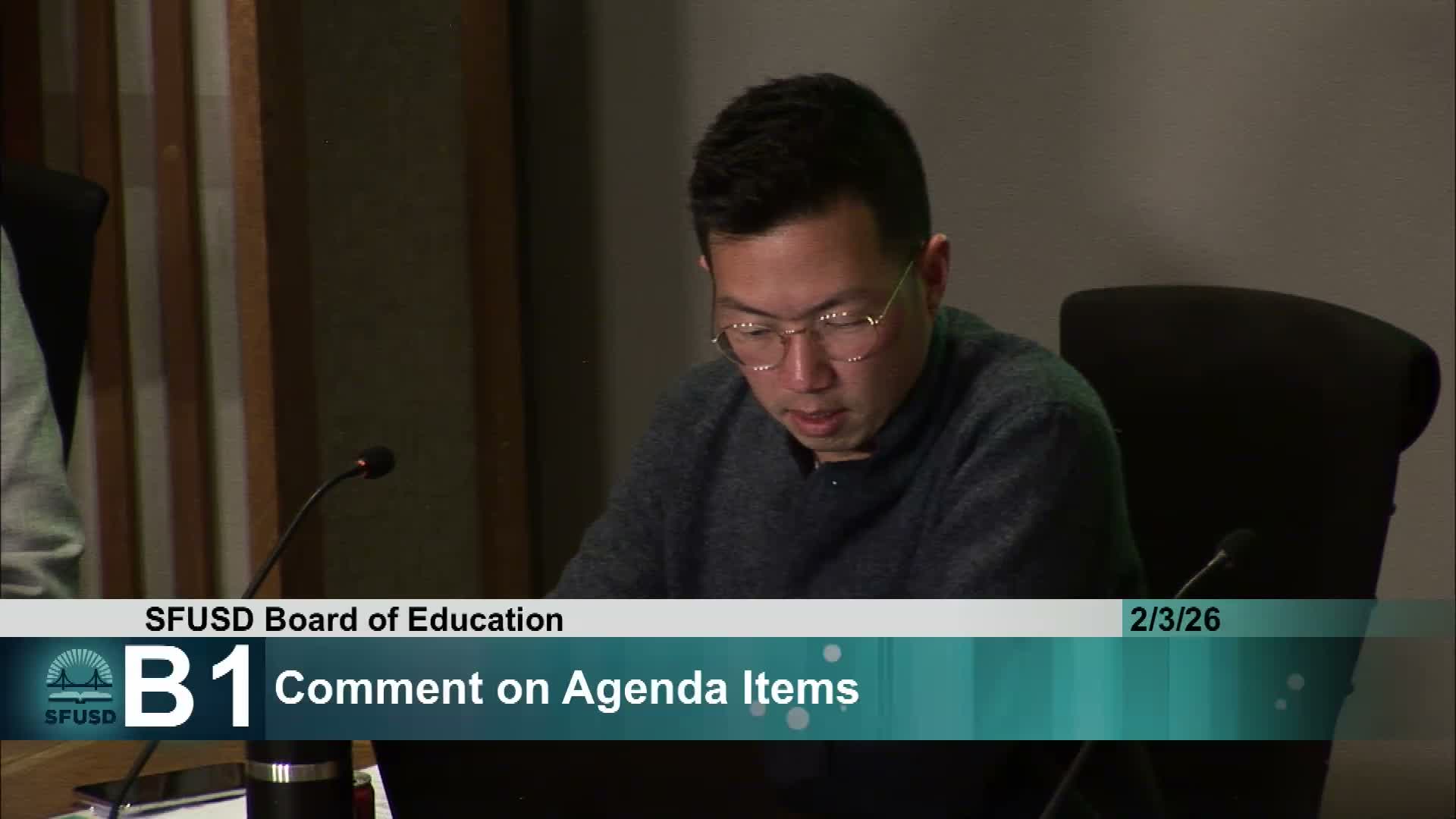
San Francisco school board approves emergency authority for superintendent if educators strike amid heated public comment
Summary
The San Francisco Unified School District Board voted 4–3 to grant the superintendent limited, time‑sensitive authority to negotiate temporary service arrangements, redeploy staff and seek state waivers to maintain operations and student safety if educators strike; commissioners and public commenters urged immediate return to bargaining.
The San Francisco Unified School District Board of Education voted 4–3 on Feb. 3 to approve a resolution authorizing the superintendent to take time‑sensitive operational steps to maintain district operations and student safety if educators enact a strike.
The board passed the measure after more than an hour of public comment in which teachers, parents, students and union representatives urged the district and board to return to the bargaining table and criticized district communications as misleading. Superintendent Hsu introduced the resolution and repeatedly said, "I do not want a strike" and that the authorization was a preparatory measure she hoped never to use.
The resolution allows the superintendent, if activated, to negotiate temporary changes with contractors and existing partners (for example, expanding hours with nonprofit partners already under MOU), redeploy current staff to emergency roles, and request waivers or clarifications from the state on mandated programs such as preschool. Counsel said any new or altered contracts would be returned to the board for subsequent ratification. "We will still need to report back to the board all of my actions," Hsu said during discussion.
Board members and the public debated the scope and timing of the authorization. Commissioner Alexander said discussing strike readiness before exhausting bargaining "sends the message" that a strike is inevitable and urged the board to consider how to use the district's roughly $420 million fund balance. Superintendent Hsu and others responded that only about $102 million is unrestricted and that planning is necessary given the district serves about 50,000 students across more than 120 schools.
Several public speakers alleged the district's recent emails misrepresented bargaining status and urged the board to present written offers rather than "PR spin." Sarita Levine, a member of the UESF bargaining team, said the district had crossed out UESF proposals and that some district claims (for example, a "48‑hour waiting period") were incorrect. "This is not good faith bargaining whatsoever," Levine said.
Superintendent Hsu also cited financial risks tied to lost instructional days and state requirements, saying the district could face fines and funding losses that district staff estimated could range from about $7 million to $10 million per day in the event of significant lost instruction. Hsu said the district expected a fact‑finding report the following Wednesday and she wished to "come back to the table on Thursday" to seek settlement discussions.
During roll call on the motion, the recorded votes were: Commissioner Ray — yes; Commissioner Alexander — no; President Kim — yes; Commissioner Wiseman Ward — yes; Commissioner Gupta — yes; Commissioner Fisher — no; Student delegate Monde — no. The motion to approve the resolution passed 4–3. The board adjourned at 6:41 p.m.
Next steps identified at the meeting included review of the fact‑finding report and an explicit invitation from the superintendent to resume negotiations the day after that report is issued. The resolution requires the superintendent to report back to the board on any actions taken under the authorization so the board can ratify changes to contracts or MOUs.