Get Full Government Meeting Transcripts, Videos, & Alerts Forever!
Get email alerts on the Local Coastal Program topic
No spam. Unsubscribe anytime.
Arcata City Planning Commission continues Local Coastal Program update after staff reports sea level rise conflict with Coastal Act
Summary
City staff told the Planning Commission on Oct. 14 that work with California Coastal Commission staff remains underway and that sea level rise policies are the primary area of conflict; the commission voted to continue the public hearing to Feb. 17, 2026 while staff refines draft LCP edits and posts track-changes online.
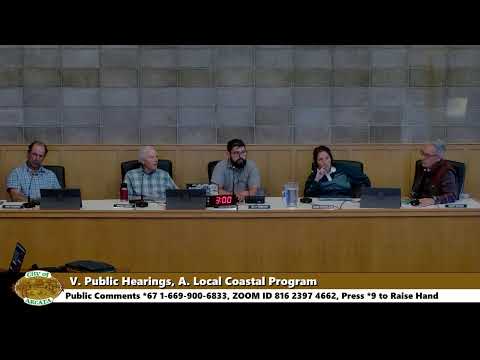
Arcata City’s Planning Commission on Oct. 14 heard a staff update on a comprehensive revision to the city’s Local Coastal Program and voted to continue the public hearing to Feb. 17, 2026 to allow additional negotiation with the California Coastal Commission.
Community Development Director David Loya told the commission that staff needs more time to resolve outstanding edits after multiple meetings with Coastal Commission staff. “We’re gonna need to continue this item one more time,” Loya said, adding that staff is meeting with Coastal Commission staff weekly to pursue conflict resolution on specific policies.
The central sticking point, Loya said, is the city’s proposed sea level rise approach. “Sea level rise is the sticking point,” he said, explaining the Coastal Commission interprets the Coastal Act to allow protective armoring—such as seawalls—for development built before the Act’s 1976 enactment while generally not extending the same entitlement to later development. Loya said that interpretation raises trade-offs the city must weigh, including potential water-quality impacts if engineered protections are used in vulnerable areas.
The staff presentation emphasized a narrow drafting approach: include only the minimum necessary provisions in the certified LCP that the Coastal Commission must rely on, and keep other design and frontage standards in the citywide zoning ordinance. Loya said the city is working to avoid duplicative or irrelevant provisions in the LCP and is posting draft edits on the city’s LCP update webpage in track-changes format so commissioners and the public can follow iterations.
Commissioners also discussed accessory dwelling unit (ADU) rules. Loya noted ADU law remains in flux at the state level and said the city’s preferred approach is to reference state ADU law where possible rather than copy large, frequently changing statutes into the LCP. He pointed to a state change enacted the same day that shortens review timelines: 15 days to determine whether an application is complete and 60 days to approve a completed application, which Loya said increases pressure to create a clear ministerial pathway in coastal areas.
Questions from commissioners focused on the Coastal Commission’s scope and why certain design requirements would or would not be included in the LCP. Commissioner Strickland said the Coastal Commission’s involvement in building-code-type issues felt “excessive” and expressed frustration about delays; Loya replied that certification under the Coastal Act is the mechanism by which the Coastal Commission delegates land-use authority and that it therefore has a role in verifying local procedures in retained-jurisdiction areas.
Staff also described two map amendments: adding several parcels near Spear and the start of James Road to a residential-medium designation and creating a new “commercial visitor-serving” zone for portions of South G and H Streets to encourage tourism-serving uses. Loya said the city plans to include the Little Lake site in the visitor-serving designation; he updated the commission that excavation at Little Lake discovered a small contamination hot spot that was re-excavated and is now being backfilled pending confirmation sampling.
Votes at a glance - Motion to approve minutes of Aug. 12, 2025 (consent): moved and seconded; voice vote in favor; motion passed. - Motion to continue the LCP public hearing to Feb. 17, 2026: moved and seconded; voice vote in favor; continuation approved.
The Planning Commission’s next substantive opportunity to weigh the LCP text will be when staff returns with revised draft edits after further coordination with Coastal Commission staff. Staff also asked commissioners to flag any specific provisions they want staff to resist or emphasize during Coastal Commission negotiations so those positions can be relayed during ongoing meetings.
Chair Simmons adjourned the meeting after brief commissioner updates and reminders about a canceled Nov. 11 meeting and an economic development survey available on the city website.