Get Full Government Meeting Transcripts, Videos, & Alerts Forever!
Get email alerts on the Housing topic
No spam. Unsubscribe anytime.
Humboldt RHNA method chosen; Arcata told to plan for about 1,000 units despite concerns
Summary
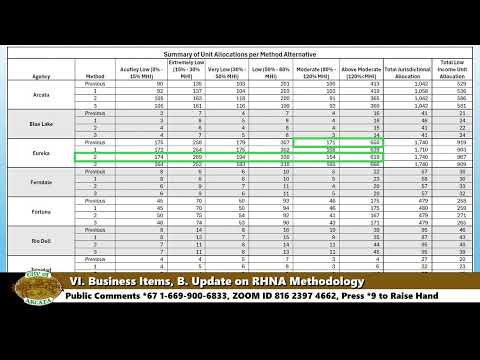
Humboldt COG adopted a RHNA methodology (Method 2) emphasizing VMT and AFFH factors; Arcata staff said the regional total is effectively about 6,000 units for the eight‑year cycle and that Arcata’s allocation is roughly 1,000 units, which the city must plan for though staff called the targets 'ludicrously high.'
Community Development Director David Loya presented an update on the Humboldt County RHNA (Regional Housing Needs Allocation) methodology and what the adopted approach means for Arcata's housing element. Loya said HCOG approved Method 2 and that Eureka has appealed the decision. "The numbers for this cycle are so ludicrously high that no one is expecting that we're ever going to meet them in the first place," Loya said.
Loya explained RHNA is the first step in the housing element process and that HCOG subdivided the regional total across jurisdictions using a mix of jobs and population weighting, with adjustments for opportunity scores intended to 'affirmatively further fair housing' and for vehicle‑miles‑traveled (VMT) reductions. He described three alternatives the regional planning group considered; staff recommended Alternative 3 (a balanced approach with AFFH and VMT), but HCOG adopted Method 2, which places a heavier emphasis on work‑based VMT and AFFH opportunity scoring.
For the region, Loya described total units discussed in the meeting as roughly in the 6,000‑unit range for the eight‑year period and said Arcata’s allocation is on the order of 1,000 units. He cautioned that the income‑category splits changed modestly under the adopted method and that Arcata saw a small shift in higher‑ and moderate‑income unit assignments. Loya warned that housing elements must be planned to these numbers even if they appear unachievable, because failure to adopt a certified housing element can jeopardize state funding and subject jurisdictions to enforcement tools such as builder remedies.
Loya described the appeal process timeline: HCOG adopted the methodology in December 2025 and the HCD 60‑day review period runs into March; Eureka filed an appeal during that period. Staff asked whether the appeal hearing could occur while HCD reviews the methodology so jurisdictions can avoid delays that would compress local housing‑element schedules. "We're trying to push for multitracking these things to streamline the process as much as possible," Loya said.
Commissioners raised questions about how Cal Poly land purchases around Arcata reduce local sites available to count toward RHNA, concerns about the allocation to the unincorporated county and whether pushing VMT‑weighted allocations would encourage sprawl. Commissioners and staff discussed that new RHNA factors (rent burden and unhoused population) increased the regional total this cycle and that Arcata has historically performed well on low‑income housing production.
Public commenters echoed the commission's skepticism: Joanne McGarry called the numbers "ludicrous" and urged the city to consider equity, homelessness and the climate action plan when responding. Staff emphasized work already underway through a HUD Pro‑Housing grant and local planning efforts that the city will continue to use in implementing its housing element.
The commission discussed next steps, including continuing housing-element work that does not require finalized RHNA numbers, monitoring the appeal process, and returning to the commission with policy options and potential programmatic responses to meet obligations while preserving local objectives.
No formal vote on a local housing‑element action was taken at this meeting.