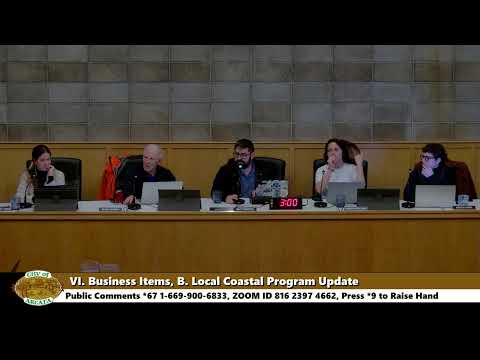
Arcata planning commissioners endorse Option 2 for commercial visitor‑serving overlay as part of Local Coastal Program update
Loading...
Summary
The Arcata City Planning Commission signaled unanimous support for a flexible, percentage‑based commercial visitor‑serving overlay (Option 2) during review of its Local Coastal Program update, while staff said sea‑level rise language has been refined and ADU standards remain under discussion with Coastal staff and HCD.
Arcata City Planning Commission members on the record expressed unanimous support for a flexible, percentage‑based commercial visitor‑serving overlay (Option 2) as part of a broader Local Coastal Program (LCP) comprehensive update.
Staff presented three LCP focus areas — sea‑level rise amendments, accessory dwelling unit (ADU) amendments, and commercial visitor‑serving (CVS) overlay proposals — and said they have been meeting frequently with Coastal Commission staff to refine language and improve the submittal’s likelihood of certification. Staff described refined sea‑level rise wording for Baylands berms and levees that would allow repair, replacement or relocation where new habitat is created, but cautioned the Coastal Commission’s legal review will be the final test of certifiability.
On ADUs, staff said earlier coordination with the California Department of Housing and Community Development (HCD) had suggested alignment, but Coastal Commission reviewers raised an open question about whether the ADU section supplies sufficiently objective standards and delineated environmentally sensitive habitat buffers to allow ministerial approvals in some locations without predictable denials for ADUs proposed in wetlands. Commissioners were asked to review that language and offer feedback.
The CVS discussion focused on two alternatives. Option 1 emphasized pedestrian‑oriented frontage and a more traditional ‘‘priority use’’ framework (retail, restaurants, hotels and similar visitor‑serving activities). Staff warned that strict priority‑use rules can exclude viable existing businesses. Option 2 proposed a site‑level, percentage‑based approach: count only commercial properties in the district (staff identified roughly 32 commercial sites in the South G Street area) and require that 25% of those commercial sites host a visitor‑serving use. Staff noted there are about 35 properties in the proposed district overall, of which 17 currently have commercial uses and approximately 10 are presently visitor‑serving.
Commissioners voiced preference for Option 2 and the chair reported a unanimous agreement among those present. Staff will communicate the commission’s preference to Coastal Commission staff and proceed without further map revisions for the proposal as drafted. Staff said the commission will take up the most complete LCP package at a continued hearing; the timeline discussed in the meeting projected a commission reprise on Feb. 24 and a City Council hearing on March 4 before submittal to the Coastal Commission.
Consultant Ben Noble was acknowledged for drafting and tracking multiple revisions, and a commissioner suggested the South G Street commercial area and Little Lake property be informally called “SOSA (South Of Samoa).” Little Lake was described as likely to include public‑use dedications (trails and a Butcher Slough realignment) alongside future sea‑level‑rise protections.
Next steps: staff will incorporate commissioner feedback on ADU objective standards, transmit the commission’s Option 2 preference to Coastal staff, and return the most complete LCP package at the continued hearing for a formal recommendation to City Council.