
Tennessee DOE offers Section 504 training for LEA staff, stresses 504–IDEA differences and procedural safeguards
Get AI-powered insights, summaries, and transcripts
Subscribe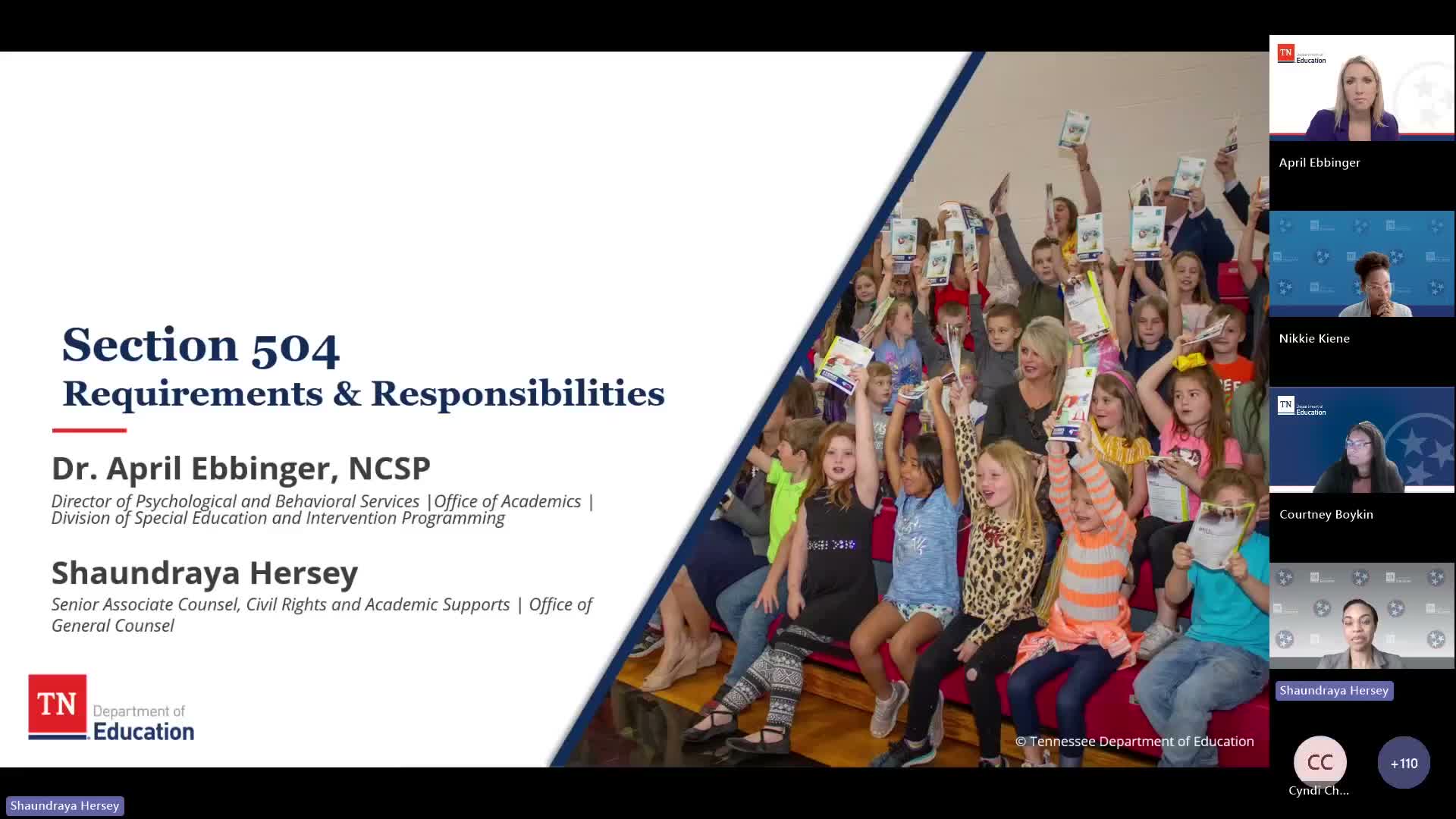
Summary
State education attorneys and psychologists led a virtual training for LEA staff reviewing Section 504 obligations, differences with IDEA, evaluation best practices (including a 60‑day IDEA timeline recommendation), grievance options, discipline (MDRs) and accessibility duties; presenters also highlighted TN PULSE case‑management tools.
Shondrea Hirsi, Assistant Counsel for Civil Rights and Academic Support at the Tennessee Department of Education, and April Evinger, the department's director of psychological and behavioral services, led a statewide webinar for local education agencies on Section 504 compliance and practice.
The presenters framed Section 504 as a federal civil‑rights access law in the Rehabilitation Act of 1973 that prohibits disability discrimination and requires LEAs to ensure equal access to programs, activities and facilities for students with disabilities. "Section 504 is an access law," Evinger said, contrasting it with IDEA's focus on specially designed instruction. Hirsi added that 504 protections can apply whether or not a student has a formal plan: "A student who has diabetes and does not need a 504 plan is still a person with a disability and still protected by Section 504."
The training underscored several recurring obligations for districts. LEAs must adopt and publish a Section 504 policy that includes an anti‑discrimination statement and grievance procedures; operate a child‑find program to notify families annually about services; respond to complaints (including bullying and harassment) in a prompt, equitable way; and document actions so a later review by the U.S. Department of Education can show the district did not act with "deliberate indifference." Hirsi cited a recent federal decision (06/12/2025) holding that parents seeking damages under Section 504 or the ADA must prove a school district acted with deliberate indifference.
On evaluations, presenters emphasized that teams must collect multiple sources of data and not rely only on a parent's outside medical diagnosis. April Evinger explained that teams should tailor assessments (observations, teacher input, nurse logs, rating scales, etc.) to answer three questions: does the student have a qualifying disability under Section 504, what are the student's educational needs, and does the impairment substantially limit one or more major life activities. She noted districts commonly "lean into IDEA" where Section 504 is silent, and recommended treating initial evaluation timelines as 60 calendar days (the IDEA standard) to avoid delays in services. The department's TN PULSE case‑management tool was presented as a means to collect documentation and track consent and timelines.
Presenters also addressed mitigating measures and eligibility: since 2009 LEAs must determine eligibility without considering ameliorative effects of measures such as medication or prosthetics (i.e., assess pre‑medication). They discussed transitory impairments (expected duration six months or less) and the ‘‘technically eligible’’ label in TN PULSE for students who may later require plans.
Regarding discipline, Hirsi explained that Section 504 requires an evaluation before a significant change in placement (generally exclusionary discipline adding up to 10 days or more). If a team determines the conduct was caused by the disability or by a failure to implement the 504 plan, the school must not apply exclusionary discipline and must reconvene the team to modify supports. Presenters noted exceptions (for instance, some illicit‑substance incidents) where the procedural protections may not apply but recommended holding a manifestation review when in doubt.
The webinar closed with practical guidance on health services (individual health plans versus 504 plans), accessibility of facilities and digital communications (noting recent ADA/website guidance changes), and coordination with postsecondary institutions for dual‑enrollment students. Attendees were directed to resources and encouraged to consult board attorneys on complex cases.
The Tennessee Department of Education said it will share the recorded session and resource links on its YouTube and resource pages and recommended district teams document outreach to parents, maintain clear timelines in case‑management systems, and coordinate with disability services at postsecondary institutions when students participate in dual‑enrollment courses.